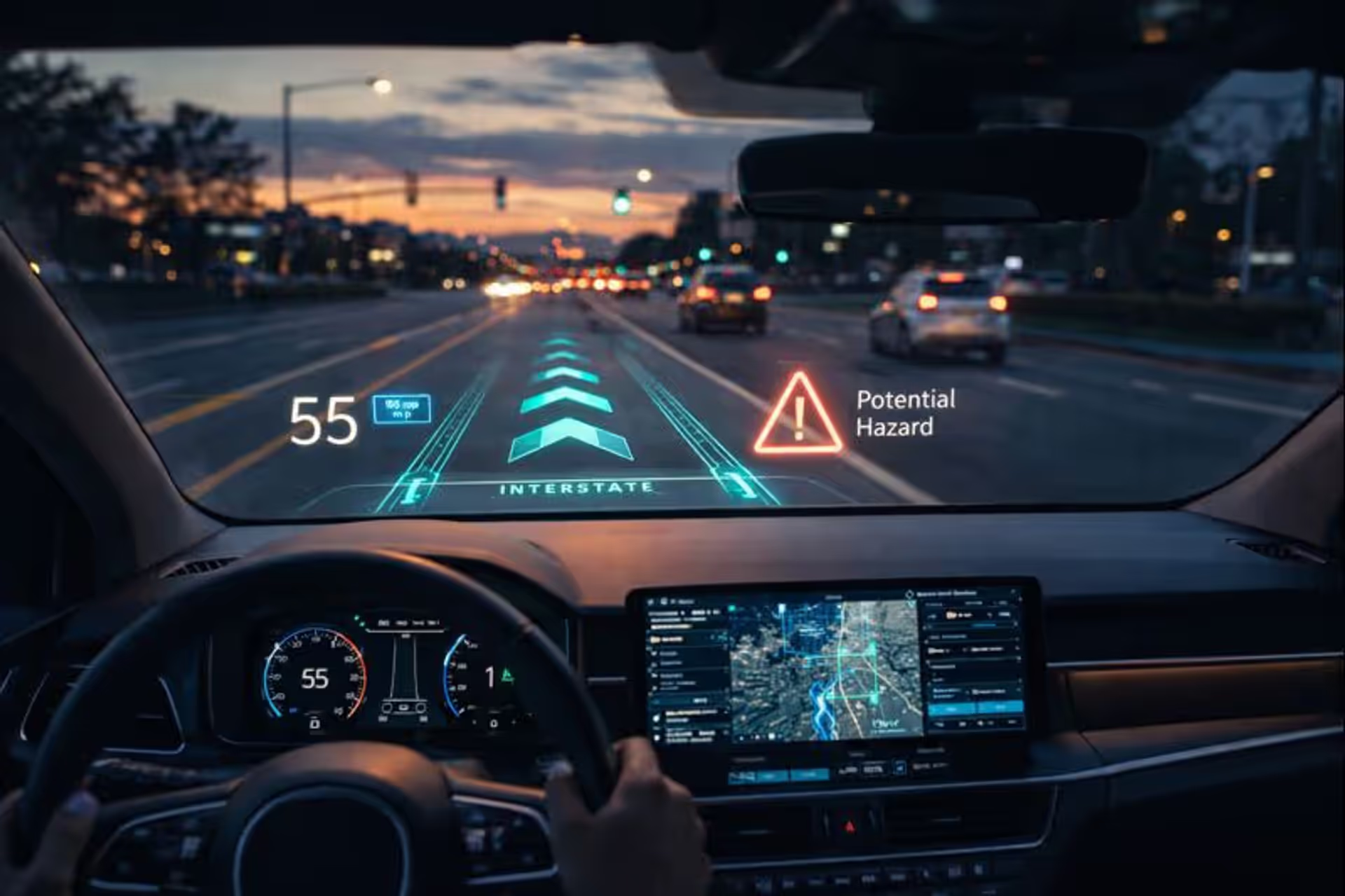
The Future of Car Displays: How Augmented Reality HUDs Are Replacing Traditional Dashboards
The Future of Car Displays: How Augmented Reality HUDs Are Replacing Traditional Dashboards

Content
Content
Introduction: The Windshield Becomes the Display
For more than a century, drivers have divided their attention between two fundamentally incompatible tasks: watching the road ahead and monitoring instruments behind the steering wheel. This division — eyes down to check speed, eyes up to track traffic, eyes down to verify navigation, eyes up to avoid hazards — represents a compromise so familiar that most drivers no longer notice it. Yet every glance away from the road creates risk. Every moment spent reading a dashboard is a moment not spent watching for the unexpected.
The head up display cars revolution promises to end this compromise. By projecting critical information directly into the driver's line of sight — onto the windshield itself or onto a transparent combiner positioned at natural eye level — automotive head up display technology keeps drivers' eyes where they belong: on the road. The information that once required looking down now floats in the visual field, integrated with the view of the world rather than competing with it.
This transformation extends far beyond simple convenience. The car head up display system represents a fundamental reconception of how humans and vehicles communicate. Where traditional dashboards present information in isolation — speed as a number, navigation as a map, warnings as icons — advanced HUD technology automotive systems contextualize information within the real world. An augmented reality navigation arrow doesn't just indicate "turn right in 200 meters"; it appears to float above the actual intersection where the turn should occur. A collision warning doesn't just flash an icon; it highlights the specific vehicle or pedestrian that triggered the alert.
The market for automotive display technology has grown dramatically as manufacturers recognize that driver interface quality increasingly differentiates vehicles in crowded segments. Premium brands have long offered head-up displays as distinguishing features; now the technology cascades into mainstream vehicles as costs decline and consumer expectations rise. The vehicle human machine interface HMI has become a competitive battleground where display sophistication signals overall vehicle advancement.
"The transition from looking down at instruments to looking through information is the most significant change in driver interface since the digital speedometer," observes an automotive HMI researcher. "We're only beginning to understand how profoundly this changes the driving experience."
— James Anderson
This analysis examines the technology underlying modern automotive displays, how augmented reality is transforming head-up displays from simple projections to contextual information systems, and how manufacturers and suppliers are competing to define the next generation of driver interfaces. Understanding these dynamics illuminates not just where advanced car display systems are heading, but why they matter for driving safety, experience, and the future of human-vehicle interaction.
How Head-Up Display Technology Works
The engineering behind head up display automotive technology combines optics, display systems, and sophisticated software to create images that appear to float in space rather than on a physical surface. Understanding these foundations illuminates both the capabilities and constraints of current systems.
The Optics of Windshield Projection
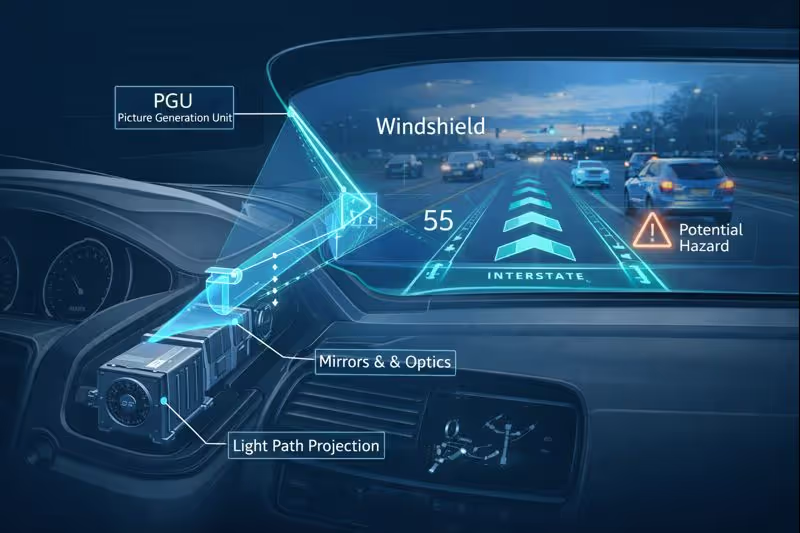
A windshield head up display creates visible images through optical principles that would seem almost magical if not grounded in well-understood physics. The system projects images from a display unit hidden within the dashboard onto the windshield, which acts as a partial mirror reflecting light back toward the driver's eyes while remaining largely transparent to the external world.
The apparent distance of HUD images — how far away they seem to float — results from optical design rather than actual light positioning. A windshield projection display car system uses mirrors and lenses to create a virtual image that appears significantly farther from the driver than the physical components that generate it. Current systems typically create images appearing 2-3 meters ahead of the driver for basic HUDs, or 10-15 meters ahead for advanced AR systems. This distant apparent position allows drivers to view HUD information without refocusing their eyes from the road, reducing the visual accommodation effort that reading close instruments requires.
The windshield itself presents engineering challenges that windshield projection technology must address. Standard automotive glass is not optically perfect — its varying thickness and curvature can distort projected images or create double images (ghosting) if the front and rear surfaces both reflect light. Premium HUD implementations use specially manufactured windshields with precise geometry and sometimes embedded optical elements that optimize reflection while minimizing distortion. The cost and complexity of these windshields explain partly why early HUD adoption concentrated in premium vehicles where such components could be absorbed into already-elevated price points.
Combiner displays offer an alternative approach, projecting images onto a small transparent panel that rises from the dashboard rather than using the windshield itself. This approach avoids windshield optical challenges and reduces cost but creates a smaller display area positioned less naturally within the driver's view. The trade-off between combiner simplicity and windshield integration defines a key choice in car hud system design, with premium implementations increasingly favoring windshield projection despite its greater complexity.
Display Technologies Behind HUD
The image sources within HUD systems have evolved significantly, with each technology generation enabling new capabilities. The automotive transparent display technologies underlying modern HUDs determine brightness, resolution, color accuracy, and ultimately what information can be effectively communicated.
Early HUD systems used vacuum fluorescent displays (VFD), producing the characteristic green monochrome images familiar from fighter aircraft and early automotive implementations. These displays offered adequate brightness but limited color and resolution. Thin-film transistor (TFT) LCD technology expanded capabilities, enabling full-color displays with higher resolution but facing brightness limitations in direct sunlight conditions.
Digital Light Processing (DLP) technology, using millions of microscopic mirrors to create images, has become dominant in premium hud display automotive applications. DLP systems achieve brightness levels that remain visible in the harshest sunlight while supporting the resolution and color depth that advanced graphics require. The technology scales well to the larger display areas that augmented reality applications demand.
Laser-based displays represent the current frontier, scanning precisely controlled laser beams to create images with exceptional brightness, infinite focus depth, and potentially wider color gamut than competing technologies. The next generation automotive displays from leading suppliers increasingly employ laser scanning for AR HUD applications where image quality and brightness directly affect usability and safety.
Augmented Reality HUD: The Next Frontier
The transition from conventional head-up displays to augmented reality hud cars represents a qualitative leap in capability rather than incremental improvement. Where traditional HUDs overlay static information onto the windshield view, AR head up display automotive systems integrate dynamic graphics with the real world in ways that transform how drivers perceive and respond to their environment.
How AR HUD Differs from Traditional HUD
A traditional HUD displays information — speed, navigation directions, warning icons — in a fixed position within the driver's view. The information floats at a consistent apparent distance regardless of what's actually ahead. This approach improves upon looking down at instruments but still requires cognitive effort to relate displayed information to real-world conditions. When the navigation shows "turn right," the driver must mentally connect that instruction to the actual intersection visible through the windshield.
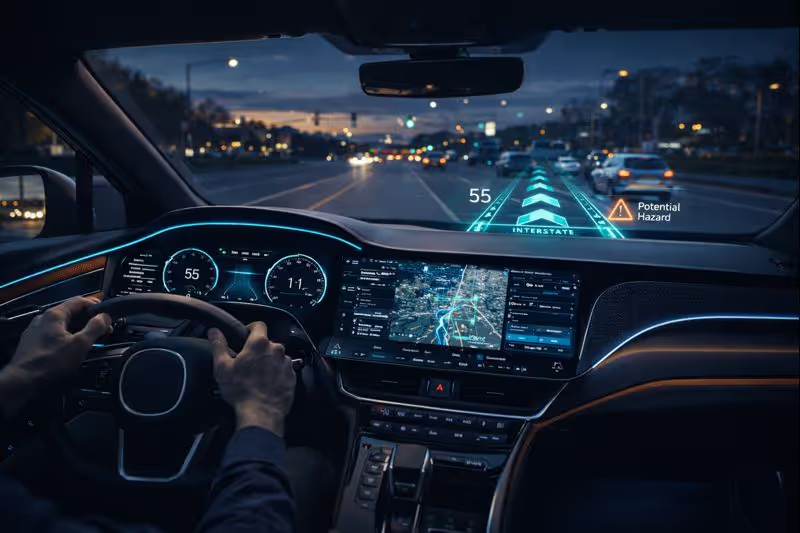
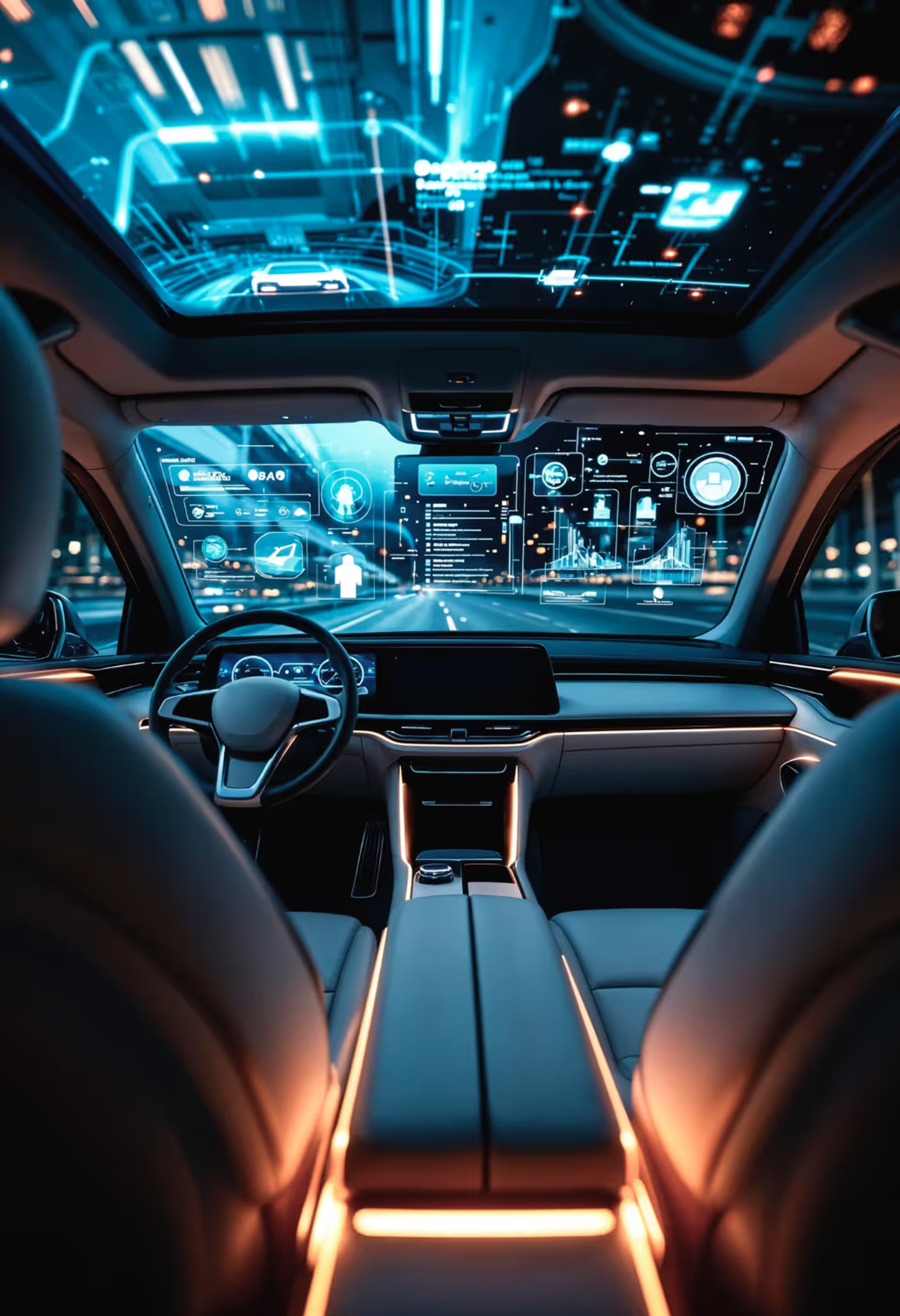
An augmented reality car windshield display eliminates this cognitive translation by placing information precisely where it relates to the physical world. The navigation arrow appears to float above the specific lane where the driver should position the vehicle, moving and rotating to match perspective as the vehicle approaches. Lane departure warnings highlight the actual lane markings being approached. Collision alerts draw attention to the specific vehicle or pedestrian that triggered the warning. The information isn't just displayed; it's positioned within the scene in ways that leverage human spatial perception.
This contextual positioning requires sophisticated technology beyond what traditional HUDs employ. The system must know precisely where the vehicle is, where it's heading, what objects surround it, and how to project graphics that appear correctly positioned from the driver's perspective. Errors in any of these elements — incorrect vehicle position, misaligned projection, lag between reality and display — create graphics that float inappropriately, potentially confusing rather than helping drivers.
The AR hud automotive technology stack therefore integrates with vehicle perception systems, precise localization, and real-time rendering in ways that conventional HUDs do not require. The AR HUD becomes not a standalone display system but a visualization layer for vehicle intelligence, presenting what the vehicle knows about its environment in forms that humans can intuitively understand.
The Safety Case for Augmented Reality
The head up display safety benefits that justify AR HUD investment extend beyond the basic advantage of keeping eyes on the road. The contextual nature of AR information changes how drivers process and respond to safety-relevant situations.
Research into driver attention and response times consistently shows that contextual warnings — those that identify what to respond to, not just that response is needed — produce faster and more appropriate reactions. A warning icon that flashes generically requires the driver to identify the hazard independently; a graphic that highlights the specific pedestrian stepping into the road directs attention precisely where it's needed. The difference in response time, while measured in fractions of seconds, can determine whether incidents are avoided or merely mitigated.
The driving safety display technology capabilities of AR HUD prove particularly valuable in complex traffic situations where multiple hazards compete for attention. Highway merging, urban intersections, construction zones — environments where conventional warnings might overwhelm with alerts while failing to prioritize — benefit from AR systems that can direct attention sequentially to the most relevant concerns. The display becomes not just information source but attention management system, guiding perception toward what matters most.
"The safety value of AR HUD isn't just about showing information — it's about showing the right information at the right place at the right moment," explains an automotive safety systems engineer. "Contextual presentation changes driver behavior in ways that aggregate data supports even when individual drivers don't consciously notice."
— James Anderson
Author: James Anderson;
Source: Where virtual meets reality on the road.
Digital Cockpits: The Integration of Vehicle Displays
The automotive head up display exists within a broader transformation of vehicle interiors toward fully digital interfaces. The digital dashboard cars evolution has replaced mechanical gauges with screens, integrated infotainment with vehicle controls, and created vehicle digital cockpit environments where information flows seamlessly across multiple displays.
From Analog to Digital Instrument Clusters
The digital instrument cluster automotive transition began as a premium feature mimicking analog gauges on digital screens but has evolved into fundamentally new approaches to presenting vehicle information. Early digital clusters replicated familiar speedometer and tachometer designs in pixels rather than needles — a skeuomorphic approach that eased transition but failed to exploit digital capabilities.
Contemporary smart car display systems abandon analog metaphors in favor of information architectures designed around digital strengths. Displays reconfigure dynamically based on driving mode, showing detailed performance data on track, efficiency information during hypermiling, or navigation-dominant layouts during wayfinding. Information density adjusts to circumstances — simplified displays during routine driving, enriched presentations when complexity demands more data. The constraints that defined analog instruments — fixed gauge positions, predetermined scales, static layouts — simply don't apply.
The automotive digital cockpit extends beyond the instrument cluster to encompass all displays within the driver's environment. Center screens for infotainment and vehicle controls, passenger displays for entertainment and comfort settings, rear-seat screens in premium vehicles — all potentially integrate into coherent systems where information moves between screens as context demands. Navigation that begins on the center display can transfer to the instrument cluster when a turn approaches, then appear in the HUD at execution moment, creating information continuity across the cockpit environment.
Human-Machine Interface Evolution
The sophistication of vehicle human machine interface HMI design has grown alongside display capabilities. Early touchscreens simply digitized buttons; contemporary interfaces incorporate gesture recognition, voice control, eye tracking, and haptic feedback in multi-modal systems that adapt to driver preferences and situational demands.
The integration challenge multiplies as displays and input methods proliferate. A driver interacting with navigation, audio, climate, vehicle settings, and phone functions through voice, touch, gesture, and physical controls requires interface design that maintains coherence across modalities. The advanced driver assistance display systems presenting safety information must integrate with these other functions without creating conflicts or confusion. A collision warning must command attention regardless of what other interaction is occurring; a navigation instruction must remain comprehensible even when the driver is simultaneously adjusting audio settings.
The trend toward larger and more numerous displays has sparked debate about whether maximizing screen area serves driver interests or merely creates additional distraction sources. Research on display design suggests that information architecture matters more than display size — a well-designed smaller display can communicate more effectively than a poorly designed larger one. The premium car display systems that lead the market increasingly emphasize design sophistication over mere screen area, though marketing pressure for impressive specifications continues driving size increases.
Technology Suppliers and the Competitive Landscape
The hud technology automotive market involves a complex ecosystem of component suppliers, system integrators, and vehicle manufacturers whose competitive dynamics shape what technology reaches production vehicles. Understanding this landscape illuminates why certain technologies advance rapidly while others lag despite apparent potential.
Key Players in Automotive HUD
The supply chain for automotive hud technology spans multiple tiers, from component manufacturers producing display elements and optical components through system integrators assembling complete HUD units to vehicle manufacturers specifying and purchasing finished systems.
At the component level, display technology comes from specialists including Texas Instruments (DLP technology), Microvision (laser scanning), and various LCD and OLED manufacturers. Optical elements — the mirrors, lenses, and specialized components that create HUD imagery — come from precision optics manufacturers including Continental, Nippon Seiki, and Denso. These components flow to system integrators who assemble complete HUD units meeting vehicle manufacturer specifications.
Major Tier 1 suppliers competing in the HUD space include Continental, Denso, Panasonic Automotive, Harman, and several others developing next generation car display technology. These companies invest heavily in AR HUD development, recognizing that augmented reality represents the growth segment while conventional HUD becomes commoditized. The competitive intensity has accelerated development timelines while driving price reductions that enable broader deployment.
Vehicle manufacturers increasingly invest in display technology directly, viewing HMI as brand-differentiating capability rather than commodity procurement. Mercedes-Benz, BMW, Audi, and other premium brands have developed proprietary display architectures and software platforms that integrate supplier hardware into distinctive brand experiences. Tesla's approach — designing display systems internally with aggressive vertical integration — has influenced how traditional manufacturers think about display technology ownership.
The Premium to Mainstream Cascade
Luxury car hud technology deployments establish technical and market foundations that eventually cascade to mainstream vehicles. This premium-first pattern reflects both economic logic — higher price points absorb technology costs more easily — and market dynamics — premium buyers value innovation while mainstream buyers require proven reliability.
The cascade timeline has compressed in recent years. Features that remained premium-exclusive for a decade in previous technology generations now migrate to mainstream vehicles within three to five years. The future car displays appearing in concept vehicles from premium brands reliably predict mainstream availability within this timeframe, allowing observers to forecast where display technology is heading even in vehicles they might actually purchase.
Table 1: Evolution of Automotive Display Technology
| Generation | Period | Display Type | Key Features | Typical Vehicles |
| First Gen | 1990s-2000s | VFD combiner | Monochrome speed, basic info | Premium sedans (BMW 7, MB S-Class) |
| Second Gen | 2005-2015 | TFT LCD combiner | Color, simple graphics | Premium expanding to mid-luxury |
| Third Gen | 2015-2022 | DLP windshield | Full color, larger image, basic AR | Premium standard, luxury standard |
| Fourth Gen | 2022-2025 | Advanced AR HUD | Contextual graphics, 10m+ throw | Premium/luxury, early mainstream |
| Fifth Gen | 2026+ | Full-windshield AR | Panoramic AR, eye-tracking | Premium debut, broad expansion expected |
Regional Perspectives: Display Technology Across Markets
The adoption and regulation of automotive display technology varies across major markets, reflecting different regulatory frameworks, consumer preferences, and competitive dynamics among regional manufacturers.
North America: Technology Adoption and Regulatory Consideration
The North American market for car head up display system technology benefits from strong consumer interest in technology features and regulatory environments that accommodate display innovation. American and Canadian consumers consistently rate advanced displays among the most desired features in vehicle purchase research, creating market pull that drives manufacturer investment.
Regulatory attention to driver distraction has influenced display design without prohibiting innovation. NHTSA guidelines recommend limiting display complexity and ensuring that safety-critical information takes priority over entertainment or secondary functions. These guidelines, while not legally binding requirements, shape manufacturer decisions about what to include in hud in modern cars implementations and how to structure driver interaction with digital cockpit systems.
The premium segment leads adoption, with German luxury brands, Tesla, and premium offerings from traditional American manufacturers featuring the most advanced systems. Mainstream adoption accelerates as technology costs decline and as competitors respond to Tesla's influence on consumer expectations about display sophistication. The future of automotive displays in North America points toward standard HUD availability even in mainstream segments within the next three to four years.
Europe: Premium Heritage and Regulatory Precision
European markets combine strong premium automotive heritage with detailed regulatory frameworks that influence display implementation. The German premium manufacturers — Mercedes-Benz, BMW, Audi, Porsche — have invested heavily in advanced car display systems, viewing HMI sophistication as essential to brand positioning in a segment where driving dynamics alone no longer differentiate adequately.
European regulations address driver distraction more prescriptively than North American guidelines. Requirements limiting certain display content while driving, mandating certain information presentations, and specifying interface behavior create compliance considerations that manufacturers must address. These requirements potentially constrain innovation but also create clearer design parameters that sophisticated manufacturers navigate effectively.
The premium segment innovation from European manufacturers sets global standards that other regions follow. The augmented reality navigation hud systems debuting in Mercedes-Benz and BMW vehicles represent the technology frontier that other manufacturers benchmark and eventually adopt. Europe's role as innovation leader in premium automotive displays seems likely to persist given the concentrated expertise and competitive intensity among regional manufacturers.
China: Rapid Adoption and Domestic Innovation
The Chinese market demonstrates remarkable appetite for automotive display technology, with domestic manufacturers deploying advanced systems at price points that would not support such features in other markets. The competitive intensity of the Chinese EV sector has made display sophistication a key differentiation vector, accelerating adoption beyond what economic logic alone would predict.
Domestic suppliers have developed holographic windshield display car and AR HUD technologies that compete credibly with established international suppliers. Companies like Huawei, entering the automotive sector with displays and other electronics, bring consumer electronics expertise that accelerates innovation cycles. The automotive display trends emerging in China often presage global developments as Chinese innovations influence international manufacturers' feature planning.
Consumer preferences in China strongly favor large, technologically impressive displays — a pattern that has influenced global vehicle development as manufacturers design for Chinese market success. The digital dashboard cars appearing in Chinese-market vehicles often feature larger screens and more aggressive display integration than comparable models in other markets, reflecting regional preferences that increasingly shape global product strategy.
Author: James Anderson;
Source: The cockpit of tomorrow, today.
Safety, Distraction, and the Display Design Challenge
The does head up display improve safety question animates ongoing research and regulatory attention. While HUD technology promises safety benefits through reduced eye-off-road time, the addition of more information to the driving environment creates potential for new distraction forms that careful design must address.
Evidence on HUD Safety Benefits
Research on hud benefits driving consistently demonstrates reduced eye-off-road time when information displays in head-up position rather than requiring downward glances. Studies using eye-tracking technology show that HUD users maintain forward gaze more consistently than drivers using conventional instrument clusters, with the difference most pronounced during periods requiring frequent information checks — navigation-guided driving, for example, or monitoring during dynamic speed adjustments.
The translation from reduced eye-off-road time to actual crash prevention is more complex to establish. Crash statistics cannot easily isolate HUD influence from the many other factors affecting accident rates. The vehicles equipped with advanced HUD systems typically include other safety technologies — automatic emergency braking, lane keeping assistance, adaptive cruise control — whose effects intermingle with any HUD contribution. Simulation studies and controlled experiments provide supportive evidence, but real-world validation remains limited by these confounding factors.
The head up display safety benefits appear strongest when displays present genuinely useful information in intuitive formats. A HUD showing only current speed provides modest benefit; one showing navigation guidance, speed limit warnings, and ADAS status provides substantially more value. The safety case depends not just on information positioning but on what information is positioned — a distinction that influences design priorities and regulatory attention.
The Distraction Paradox
Adding displays to the driving environment creates potential for distraction even when those displays aim to reduce it. A poorly designed HUD that presents excessive information, changes unexpectedly, or requires cognitive effort to interpret can degrade driving performance despite optimal positioning. The driving safety display technology challenge involves balancing information value against attention cost — providing what drivers need without overwhelming or distracting them.
The augmented reality approach presents particular challenges. Graphics that overlay the real world must integrate seamlessly; graphics that conflict with or obscure actual conditions can confuse rather than clarify. An AR navigation arrow appearing in the wrong position, or persisting after a turn is complete, or conflicting with actual road markings creates cognitive conflict that demands attention to resolve. The precision requirements for AR HUD — accurate positioning, appropriate timing, consistent reliability — exceed those for conventional displays precisely because the consequences of error are more severe.
"The irony of driver attention technology is that getting it wrong can be worse than not having it at all," notes a human factors researcher. "A HUD that distracts is worse than no HUD; an AR system that confuses is worse than a conventional display. The technology demands getting it right."
— James Anderson
Table 2: HUD Safety Considerations and Design Responses
| Safety Concern | Potential Risk | Design Response | Implementation Example |
| Information Overload | Cognitive saturation, missed critical info | Adaptive content filtering, priority hierarchies | Mercedes MBUX AR: situational content adjustment |
| Visual Clutter | Obscured road view, attention competition | Transparency management, minimal footprint design | BMW AR HUD: context-aware graphic density |
| Misplaced Graphics | Confusion, incorrect responses | Precision localization, error detection | Continental AR: multi-sensor position validation |
| Timing Errors | Delayed or premature information | Predictive algorithms, latency minimization | Panasonic AR: sub-frame rendering pipeline |
| Night/Glare Issues | Visibility problems, eye strain | Automatic brightness adjustment, ambient sensing | Denso systems: photosensor-driven adaptation |
| Driver Adaptation | Over-reliance, skill degradation | Balanced information provision, occasional absence | Industry debate ongoing |
The Future of Automotive Displays
The trajectory of next generation digital dashboard and HUD technology points toward increasingly immersive, intelligent, and integrated systems that transform windshields from passive glass into active display surfaces. Understanding this trajectory helps contextualize current technology within the broader evolution it represents.
Toward Full-Windshield Augmented Reality
Current AR HUD systems display information within a relatively small portion of the windshield — a "display box" perhaps 10-15 degrees of visual angle in width. The future of automotive displays points toward expanding this display area until the entire windshield becomes available for augmented reality overlay.
Full-windshield AR would enable fundamentally new information presentations. Rather than confining navigation graphics to a forward-looking box, guidance could appear wherever relevant — highlighting cross-traffic at intersections, marking pedestrians in peripheral vision, indicating parking spaces alongside the vehicle. The windshield would become a canvas for vehicle intelligence, presenting what the car knows about its environment wherever that information is spatially relevant.
The technical challenges for full-windshield AR exceed those of current systems by substantial margins. Optical systems must cover far larger areas while maintaining image quality. Processing requirements multiply as graphics must render for extended fields of view. Eye tracking becomes essential to ensure graphics appear correctly positioned from the driver's actual viewing position rather than assumed sightlines. These challenges ensure that full-windshield AR remains years from production deployment, but development programs at major suppliers confirm it as the long-term direction.
Display Integration with Autonomous Systems
The relationship between display technology and autonomous driving creates interesting design questions as vehicles transition toward greater autonomy. In partially autonomous vehicles (Level 2-3), displays must communicate system status, handoff requirements, and operational boundaries — information that doesn't exist in fully manual vehicles. In highly autonomous vehicles (Level 4-5), traditional driving displays become irrelevant, replaced by entertainment and productivity interfaces for passengers who no longer need driving information.
The transition period creates particular challenges. A vehicle capable of autonomous operation in some conditions but requiring driver attention in others must communicate those modes clearly and manage transitions safely. The advanced driver assistance display requirements for these vehicles exceed those for either fully manual or fully autonomous operation — the display must indicate what the system is doing, what it expects from the driver, and when transitions are occurring or approaching.
The premium segment's early deployment of advanced autonomy means that premium display systems will pioneer these transition interfaces. The solutions developed for Mercedes Drive Pilot and similar systems will influence how the industry approaches display design for partial autonomy broadly. The premium car display systems serving as testbeds for autonomous interface development will shape expectations and standards for the mainstream vehicles that eventually follow.
Personalization and Adaptation
Future automotive digital cockpit systems will increasingly personalize presentations to individual drivers based on preferences, behaviors, and capabilities. Eye tracking enables understanding of where individual drivers actually look, allowing display placement optimization for each user. Machine learning on driving patterns enables prediction of what information individual drivers need in specific situations. Biometric monitoring could adjust information density based on detected cognitive load or attention state.
This personalization raises privacy considerations that manufacturers and regulators must address. Systems that learn from driver behavior necessarily collect data about that behavior. The value of personalization depends on data collection that some drivers may resist. Balancing customization benefit against privacy concern will influence how aggressively manufacturers pursue adaptive display systems and how transparently they communicate data practices.
Conclusion: The Windshield as Window and Canvas
The transformation of automotive displays from dashboard instruments to immersive information environments represents one of the most significant changes in driver experience since the automobile's invention. The head up display carsevolution — from military technology adapted for luxury vehicles to augmented reality systems approaching mainstream deployment — illustrates how technological capability, manufacturing economics, and consumer expectations interact to reshape what vehicles offer and how drivers interact with them.
The automotive head up display is no longer a novelty feature distinguishing premium vehicles; it is becoming an expected element of modern automotive design. The AR head up display automotive systems debuting today will define the baseline expectations of tomorrow's vehicle buyers, just as digital instrument clusters moved from innovation to assumption over the past decade. The car head up display system that once justified premium pricing will eventually appear even in entry-level vehicles, a transformation already visible in competitive segments where display sophistication drives purchase decisions.
The safety implications of this transformation remain the most consequential and the most debated. The promise of head up display safety benefits — keeping eyes on the road while providing necessary information — offers genuine value that research supports. The risk of distraction through poorly designed or excessive display content requires ongoing attention from designers, regulators, and researchers. The technology enables both better and worse outcomes depending on implementation quality; realizing the benefits while avoiding the risks demands sophisticated design informed by human factors expertise.
For manufacturers and suppliers, the automotive display technology landscape represents both opportunity and challenge. The opportunity lies in differentiation — displays that create distinctive brand experiences and justify premium positioning. The challenge lies in execution — delivering on augmented reality's promise while avoiding distraction pitfalls, meeting escalating consumer expectations while managing costs, and navigating regulatory environments that continue evolving.
For drivers, the evolution toward augmented reality hud cars and advanced digital dashboard cars promises vehicles that communicate more naturally and keep attention where it belongs. The windshield that once merely provided view now provides context — not just showing the road but explaining it, not just enabling vision but enhancing understanding. This transformation continues, with each generation of next generation automotive displays expanding what vehicles can communicate and how intuitively they can communicate it.
The windshield has become both window and canvas, both view and interface. What we see through it remains the road; what we see on it increasingly defines how we understand and navigate that road. The future of driving looks forward — literally — through displays that make the journey safer, more informed, and more engaging than looking down at dashboards ever allowed.
Related Stories
Read more
Read more

Content on edmmnatsakanyan.com is provided for general informational and educational purposes only. It is not intended to be, and should not be construed as, professional automotive, financial, leasing, or technical advice, nor as a substitute for consultation with qualified professionals.
The information provided on this website is for general informational purposes only and may include content related to cars, luxury vehicle leasing, automotive innovations, electric vehicles, and future mobility technologies. Use of this website does not create a professional, advisory, or client relationship between edmmnatsakanyan.com and the user.
Edmmnatsakanyan.com is not responsible for any errors or omissions, or for actions taken in reliance on the information contained on this website.