
Autonomous Vehicles Explained: SAE Levels, Safety Data, and the Road Ahead

Opening: The Gap Between Human Roads and Machine Logic
You're on I-95 outside Philadelphia during rush hour. Construction barrels have narrowed three lanes into one. A semi-truck is merging from your right while a sedan ahead brakes suddenly for no apparent reason. A motorcycle weaves between lanes. A faded temporary sign says "Right Lane Ends 500 Feet" but the paint is half-worn off and partially blocked by a work vehicle. You process all of this in about two seconds, adjust your speed, check your mirrors, and navigate through without consciously thinking about the dozens of micro-decisions you just made.
Now imagine asking a computer to do the same thing.ввввввв
This scenario captures the fundamental tension at the heart of AI on wheels: American roads were built by humans, for humans, in all our chaotic, context-dependent, rule-bending glory. We communicate through eye contact, hand waves, and the subtle language of vehicle positioning. We interpret faded signs, predict that the car with the turn signal probably won't actually turn, and know instinctively that a ball rolling into the street might be followed by a child. We routinely break traffic laws—rolling through stop signs, exceeding speed limits, crossing solid lines to avoid debris—because we understand that rigid rule-following sometimes creates more danger than flexibility.
Artificial intelligence, by contrast, thrives on structure, probability, and pattern recognition. It excels at processing vast amounts of sensor data simultaneously and reacting faster than any human. But it struggles with the ambiguous, the unprecedented, and the socially negotiated aspects of driving that humans handle effortlessly. Teaching a machine to drive isn't just an engineering problem—it's a problem of encoding human judgment, social norms, and contextual reasoning into systems that fundamentally don't think the way we do.
— arnold
This article examines where AI-driven vehicles actually stand today, how the technology works, why safety is so difficult to measure, what regulations govern these systems, and what the next five to fifteen years might realistically bring. The goal isn't to hype the technology or dismiss it, but to provide the clarity that press releases and headlines rarely offer. Because whether you're a driver using advanced features in your current car, a trucking company evaluating autonomous systems, or a city planner wondering how to prepare, you deserve to understand what's real, what's possible, and what remains genuinely uncertain.
Essential Terminology: Understanding What We're Actually Talking About
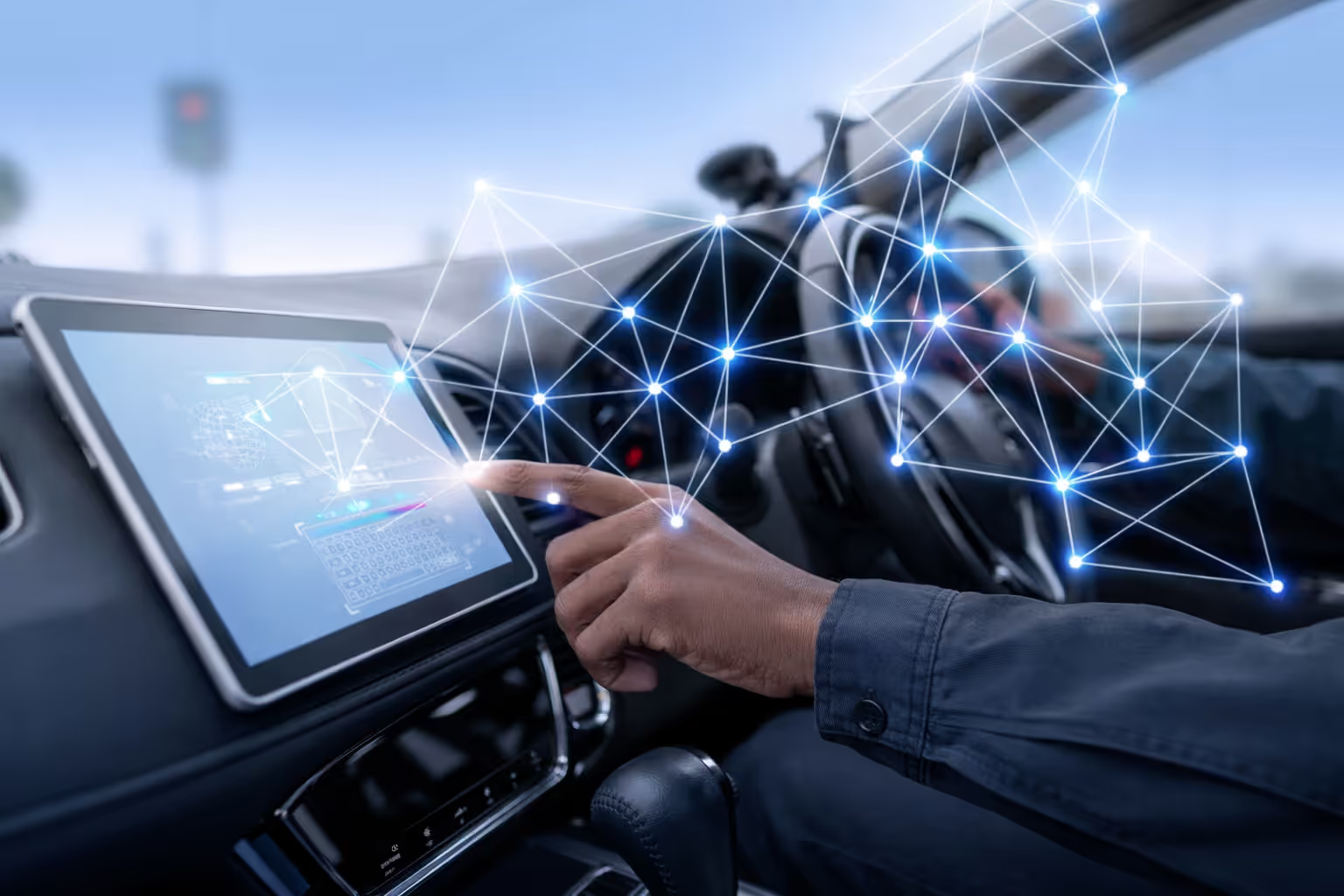
Author: Alex Johnson(test name of author of image);
Source: https:///site.com/test-of-image-source

Author: Alex Johnson;
Source: edmmnatsakanyan.com
ADAS vs. Autonomous Driving Systems

Author: Alex Johnson;
Source: edmmnatsakanyan.com
Advanced Driver Assistance Systems, commonly abbreviated as ADAS, refers to the features increasingly common in modern vehicles: automatic emergency braking, lane keeping assistance, adaptive cruise control, blind spot monitoring, and similar technologies. These systems assist the human driver but don't replace them. The driver remains responsible for vehicle operation at all times, and the systems are designed to support safe driving, not enable inattention.
Autonomous driving systems, by contrast, are designed to perform the entire driving task under certain conditions without human intervention. The vehicle's computer system monitors the environment, makes decisions, and controls the vehicle. Whether a human needs to be available to take over—and how quickly—depends on the level of automation.

Author: Alex Johnson;
Source: edmmnatsakanyan.com
The distinction matters because marketing often blurs it. A vehicle with advanced ADAS features isn't autonomous, even if advertisements emphasize hands-free capabilities or suggest the car can "drive itself." Understanding this distinction helps you evaluate both what your current vehicle can actually do and what claims about future vehicles actually mean.
Operational Design Domain: Where the System Works
Operational Design Domain, or ODD, refers to the specific conditions under which an automated system is designed to function. This includes geographic boundaries, road types, weather conditions, time of day, speed ranges, and other parameters. A system might work reliably on sunny California highways but fail in a Michigan snowstorm. It might handle freeway driving but not urban intersections. It might operate only in areas with detailed digital maps.
[content]
| Plate Section | What to Include | Purpose |
| Half of the plate | Vegetables and fruits | Vitamins, minerals, fiber |
| One quarter | Lean protein | Muscle support and satiety |
| One quarter | Whole grains | Energy and digestion |
| Small amount | Healthy fats | Brain and hormone health |
| ждьжд | ||||
|---|---|---|---|---|
| ждьжд |
ODD is perhaps the most important concept for understanding autonomous vehicle limitations. When a company says their vehicles can drive autonomously, the relevant question is: under what conditions? The answer is almost always narrower than the headlines suggest. An autonomous system that works perfectly within its ODD may be dangerous or inoperable outside those boundaries. Understanding ODD helps you recognize that "self-driving" is never a universal capability—it's always conditional on specific circumstances.
Why "Self-Driving" Is Not a Single Capability
The phrase "self-driving car" suggests a binary: either a car drives itself or it doesn't. Reality is far more nuanced. Automation exists on a spectrum, with different systems capable of handling different aspects of driving under different conditions with different requirements for human involvement.
A vehicle might be able to steer itself within a lane on a highway but require the driver to handle lane changes. Another might handle all highway driving but not city streets. Another might drive autonomously in a specific neighborhood but require human control elsewhere. Another might never need human intervention under any circumstances.
The Society of Automotive Engineers developed a classification system to bring precision to these distinctions. Understanding this system is essential for evaluating any claim about autonomous vehicle capability.

Author: Alex Johnson;
Source: edmmnatsakanyan.com
SAE Levels of Driving Automation: A Plain-English Guide
The SAE J3016 standard defines six levels of driving automation, from Level 0 (no automation) through Level 5 (full automation under all conditions). These levels have become the standard framework for discussing autonomous vehicle capabilities, referenced by regulators, manufacturers, and researchers.
The key questions that distinguish levels are: Who monitors the driving environment? Who performs the driving task? And who is responsible for fallback performance when the system can't handle a situation?
| SAE Level | Name | Who Monitors the Driving Environment | Who Performs the Driving Task | Real-World Examples | Availability in U.S. Today |
|---|---|---|---|---|---|
| 0 | No Automation | Human driver | Human driver | Basic vehicles with no assist features; warning systems like blind spot alerts | Widely available |
| 1 | Driver Assistance | Human driver | Human driver, with one aspect assisted by system | Adaptive cruise control (speed only); lane centering (steering only) | Widely available |
| 2 | Partial Automation | Human driver | System handles steering and acceleration/braking; human must supervise continuously | Tesla Autopilot, GM Super Cruise, Ford BlueCruise, most "hands-free" highway systems | Widely available |
| 3 | Conditional Automation | System monitors when engaged; human must be available to take over | System performs driving task within ODD; human takes over when system requests | Mercedes Drive Pilot (limited deployment in Nevada, California) | Very limited availability |
| 4 | High Automation | System monitors within ODD; no human takeover required | System performs all driving within ODD; may have no driver controls | Waymo robotaxis in Phoenix and San Francisco; Cruise (currently paused) | Geofenced deployments only |
| 5 | Full Automation | System monitors in all conditions | System performs all driving in all conditions; can go anywhere a human could drive | No examples exist | Not available |
The distinction between Levels 2 and 3 is particularly important. At Level 2, the human driver must continuously supervise the system and remain ready to take over at any moment. The system assists with driving, but responsibility never transfers to the vehicle. At Level 3, responsibility does transfer to the vehicle when the system is engaged within its ODD—but the human must still be available to resume control when the system requests.
- asdasda
- Level 4 represents a more significant shift: within its operational design domain, the vehicle handles everything, including fallback performance. If something goes wrong, the vehicle is responsible for achieving a safe state, not the human. But Level 4 systems operate only within defined boundaries—geographic areas, road types, weather conditions. Outside those boundaries, they may not function at all.
- Level 4 represents a more significant shift: within its operational design domain, the vehicle handles everything, including fallback performance. If something goes wrong, the vehicle is responsible for achieving a safe state, not the human. But Level 4 systems operate only within defined boundaries—geographic areas, road types, weather conditions. Outside those boundaries, they may not function at all.
- Level 5 would mean full automation everywhere, under all conditions, with no need for human involvement ever. No Level 5 system exists today, and many experts doubt whether true Level 5 is achievable in any meaningful timeframe given the diversity and complexity of global driving conditions.
Current State of AI-Driven Vehicles in the U.S.
The gap between what headlines promise and what actually exists on American roads is substantial. Understanding the current state requires distinguishing between three very different categories: widespread consumer systems, limited autonomous deployments, and the constraints that apply to all of them.
Widespread Level 2 Systems in Consumer Vehicles
The most common form of AI on wheels today is Level 2 partial automation in consumer vehicles. Systems like Tesla's Autopilot, GM's Super Cruise, Ford's BlueCruise, and similar offerings from other manufacturers are available on millions of vehicles already on American roads. These systems can handle steering, acceleration, and braking simultaneously on appropriate roads, allowing drivers to travel hands-free on highways under the right conditions.
These systems have genuinely impressive capabilities. They can maintain lane position, adjust speed based on traffic, and handle gentle curves for extended periods. Some include automatic lane changing functionality. They represent significant advances in driver assistance and can reduce fatigue on long highway drives.
But they remain Level 2 systems. The driver must supervise continuously. The driver must be prepared to take over immediately. The driver remains legally responsible for vehicle operation. The hands-free capability doesn't mean attention-free capability—a distinction that marketing sometimes obscures and that drivers sometimes misunderstand, with tragic consequences.The National Highway Traffic Safety Administration maintains a standing general order requiring manufacturers to report crashes involving vehicles equipped with automated driving systems. This data, while imperfect, provides some visibility into real-world performance of these systems.
Limited, Geofenced Driverless Deployments
True autonomous operation—vehicles without human drivers—exists in the United States, but only in extremely limited contexts. Waymo operates robotaxis in parts of Phoenix, Arizona and San Francisco, California, providing commercial ride-hailing service using vehicles with no human safety operator. The operational areas are carefully defined and mapped in extraordinary detail. The vehicles don't venture outside these geofenced zones.
Cruise, another robotaxi operator owned by General Motors, had similar deployments in San Francisco before suspending operations in late 2023 following an incident that raised questions about the company's transparency with regulators. The California Department of Motor Vehicles suspended Cruise's autonomous vehicle permits, and the company paused deployments nationwide.
These deployments demonstrate that Level 4 autonomous driving is technically achievable under the right conditions. They also demonstrate how narrow those conditions remain. Geofenced deployments in carefully mapped urban areas with good weather represent a tiny fraction of American driving conditions. The vehicles operate where their developers have invested enormous resources in mapping, testing, and understanding the local environment.
— Alex Johnson
Why Geography, Weather, and Infrastructure Matter
The constraints on autonomous vehicle operation reveal something important about the technology's current limitations. AI on wheels doesn't just need good sensors and algorithms—it needs environments that its perception systems can reliably interpret.
Weather affects nearly every aspect of autonomous vehicle perception. Rain, snow, fog, and glare can degrade camera, lidar, and radar performance. Snow can obscure lane markings and change road surfaces in ways that confuse mapping systems. Ice creates traction conditions that require different driving strategies. Most current autonomous deployments operate in places with relatively mild weather for good reason.
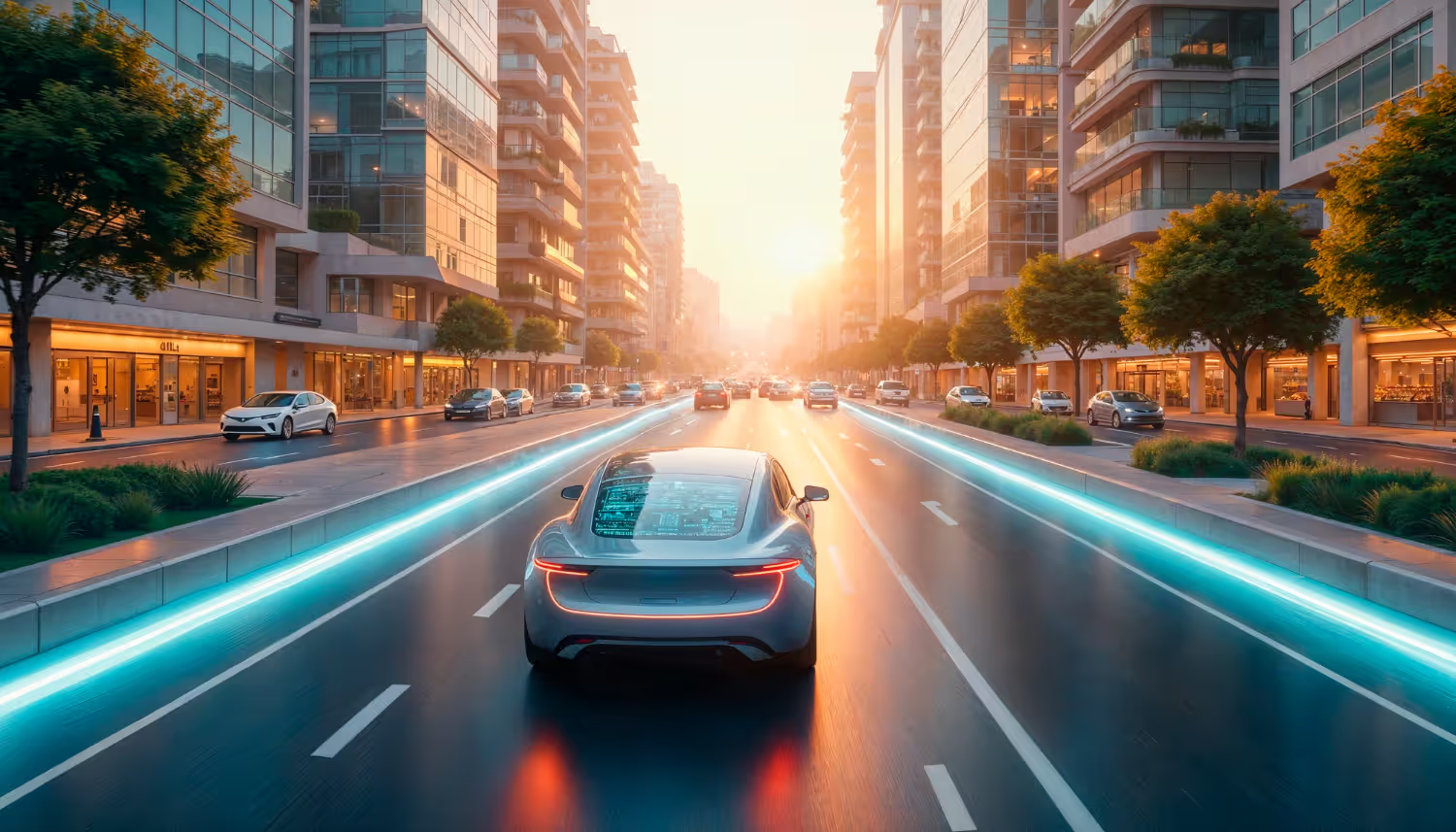
Author: image author Test;
Source: image source test
Infrastructure matters because autonomous vehicles rely heavily on detailed maps and consistent road features. Faded lane markings, unusual intersection designs, temporary construction configurations, and roads that don't match mapped expectations create challenges. The chaos of many American roads—inconsistent signage, missing lane markers, construction zones that change daily—represents exactly the kind of ambiguity that current systems struggle to handle.
Geography affects available testing and deployment areas. Urban areas with grid street patterns differ from suburban sprawl. Western roads differ from northeastern roads. What works in Phoenix may not work in Boston. The United States presents extraordinary geographic diversity, and systems developed in one region may not generalize to others.
Safety and Trust: The Central Challenge
No question matters more for the future of self-driving cars than safety. Will autonomous vehicles ultimately be safer than human drivers? Are they safe enough now? How would we even know? These questions turn out to be far more complicated than they initially appear.
Why AV Safety Is Difficult to Measure
The fundamental challenge in measuring autonomous vehicle safety is statistical: serious crashes are rare events, and demonstrating that one system is safer than another requires enormous amounts of data.
Human drivers in the United States average approximately one fatal crash per 100 million miles traveled. To demonstrate with statistical confidence that an autonomous system is safer than human driving would require that system to drive hundreds of millions of miles without a fatal crash—far more than any AV system has accumulated. Even then, questions would remain about whether testing conditions were representative of real-world deployment conditions.
Comparison is further complicated by the fact that autonomous vehicles currently operate only in favorable conditions. Comparing a robotaxi that operates only on sunny days in carefully mapped urban areas to human drivers who navigate blizzards, unmapped rural roads, and construction zones isn't an apples-to-apples comparison. The autonomous system might perform better within its ODD while being incapable of handling conditions that human drivers routinely navigate.
💬 Different metrics tell different stories. Crash rates matter, but so do near-misses, human interventions in testing, system failures that didn't result in crashes, and incidents that reveal edge cases the system doesn't handle well. A system with zero crashes but frequent near-misses might be less safe than one with a minor crash but robust overall performance.
What Data Is Collected and How
Autonomous vehicle developers collect extraordinarily detailed data from their vehicles: sensor data, perception outputs, planning decisions, vehicle controls, and outcomes. This data allows them to analyze incidents, identify failure modes, and improve systems. But most of this data is proprietary and not publicly available.
Some data does reach public hands. California requires companies testing autonomous vehicles to file annual disengagement reports with the California DMV, documenting instances where human safety operators had to take control. These reports provide limited visibility into testing performance, though they're difficult to compare across companies because disengagement criteria vary and companies may interpret reporting requirements differently.
The federal government has increased data collection requirements in recent years. NHTSA's standing general order, implemented in 2021, requires manufacturers and operators to report crashes involving vehicles equipped with automated driving systems within specified timeframes. This creates a more consistent national picture of crashes involving these systems, though reporting thresholds and definitions continue to evolve.
U.S. Crash Reporting Requirements for Automated Systems
Under NHTSA's Standing General Order, manufacturers and operators of vehicles equipped with Automated Driving Systems (Level 2 and above) must report crashes that result in fatalities, injuries, property damage requiring tow-away, air bag deployment, or impacts with vulnerable road users such as pedestrians or cyclists. Reports must be submitted within specified timeframes depending on crash severity.
This reporting requirement has generated a substantial dataset that NHTSA makes publicly available, though interpreting the data requires caution. Raw crash counts don't account for exposure (miles traveled), and higher crash counts for some manufacturers may simply reflect larger deployment fleets rather than worse safety performance. The data nonetheless provides unprecedented transparency into crashes involving automated systems and has revealed patterns that warrant attention.
The balance between public transparency and proprietary business information remains contentious. Manufacturers argue that detailed safety data is competitively sensitive and that premature release of incomplete data could mislead the public. Safety advocates argue that the public has a right to understand the risks of vehicles operating on public roads. This tension will likely persist as the technology develops.
How AI Really Drives: The Technical Stack
Understanding how autonomous vehicles work—at least at a conceptual level—helps evaluate both their capabilities and their limitations. The technical approach involves several interconnected systems working together: perception, prediction, planning, and control.
Perception: Understanding the World
Perception refers to the vehicle's ability to understand its environment using sensor data. Modern autonomous vehicles typically combine multiple sensor types: cameras that capture visual information, lidar that creates detailed 3D maps of nearby objects using laser light, radar that detects objects and measures their speed, and ultrasonic sensors for close-range detection.
Each sensor type has strengths and limitations. Cameras provide rich visual information but can be fooled by lighting conditions and can't directly measure distance. Lidar provides precise distance measurements but can be degraded by heavy rain or snow and doesn't capture color or texture. Radar works in most weather conditions but provides less detailed information about object shape and type. Combining these sensors—a process called sensor fusion—allows the system to leverage each sensor's strengths while compensating for its weaknesses.
Perception systems must identify and classify objects in the environment: other vehicles, pedestrians, cyclists, animals, road signs, traffic lights, lane markings, construction equipment, and countless other things that might appear on a road. They must determine where these objects are, how fast they're moving, and what direction they're heading. This is extraordinarily difficult because real-world scenes are cluttered, lighting varies, objects partially occlude each other, and unusual objects appear that the system may never have encountered before.
Prediction: Anticipating What Happens Next
Identifying what's in the environment isn't enough—the vehicle must predict what those objects will do. Will the pedestrian step into the street? Will the car ahead brake suddenly? Will the truck complete its lane change or abort it?
Prediction draws on patterns learned from vast amounts of driving data. The system knows that cars usually stay in their lanes, that pedestrians waiting at crosswalks often cross when the light changes, that vehicles with turn signals usually turn. But predictions are probabilistic, and humans often behave unpredictably. The pedestrian who suddenly steps into traffic, the driver who makes an unexpected U-turn, the cyclist who swerves without signaling—these violations of typical patterns are exactly the situations where prediction is most critical and most difficult.
Human drivers use social cues and contextual reasoning that current AI systems struggle to replicate. We make eye contact with pedestrians to gauge their intentions. We recognize that a driver looking at their phone might not see us. We understand that a car parked outside a school might have a child about to exit. We interpret body language, vehicle positioning, and countless other subtle signals. Teaching machines to recognize and appropriately respond to these cues remains an open research problem.
Planning: Deciding What to Do
Given perception of the current environment and predictions about how it will evolve, the vehicle must decide what to do: what path to follow, what speed to travel, when to change lanes, how to respond to unexpected events. This is the planning function.
- Planning involves optimizing across multiple objectives that sometimes conflict: reaching the destination efficiently, maintaining safety margins, following traffic rules, providing comfortable ride quality, and behaving in ways that other road users can predict and understand. A planning system that optimizes only for safety might never make progress; one that optimizes only for speed might be dangerous. Finding the right balance is as much an art as a science.
- Planning must also handle the combinatorial explosion of possible scenarios. At any moment, the vehicle could accelerate, brake, turn, or maintain course. Other vehicles could do the same. Pedestrians might step into the street. Traffic lights might change. The number of possible futures explodes rapidly, and the planning system must consider enough of them to make good decisions while operating fast enough to respond to a dynamic environment.
Control: Executing the Plan
Control refers to the low-level systems that actually operate the vehicle: steering, throttle, brakes. Given a plan, the control system translates high-level commands into physical vehicle movements. This involves understanding vehicle dynamics—how the specific vehicle responds to control inputs—and executing commands precisely.
Control systems must operate reliably under all conditions, with appropriate responses to component failures. If a sensor fails, if a computing unit malfunctions, if communication between systems is interrupted, the control system must respond appropriately—ideally degrading gracefully rather than failing catastrophically.
— Author Zubenko Micail
Edge Cases: The Long Tail Problem
The fundamental challenge for autonomous vehicles isn't handling typical driving situations—it's handling the enormous variety of unusual situations that human drivers routinely encounter. A construction worker directing traffic in an unexpected location. An overturned truck blocking the road. A traffic signal malfunctioning. An animal in the road. A driver making an illegal maneuver. An emergency vehicle approaching from an unusual direction.
These edge cases are individually rare but collectively common. Over enough miles, unusual situations are guaranteed to occur. And because they're unusual, they're underrepresented in training data, harder to test, and more likely to confuse perception, prediction, and planning systems.
The "long tail" of edge cases represents perhaps the greatest technical challenge facing autonomous vehicle development. Each edge case identified and addressed reveals others. The diversity of American roads means edge cases vary by region. And some edge cases are so rare that they may never be encountered in testing, only to appear in deployment.
The Next 5–15 Years: Three Realistic Scenarios
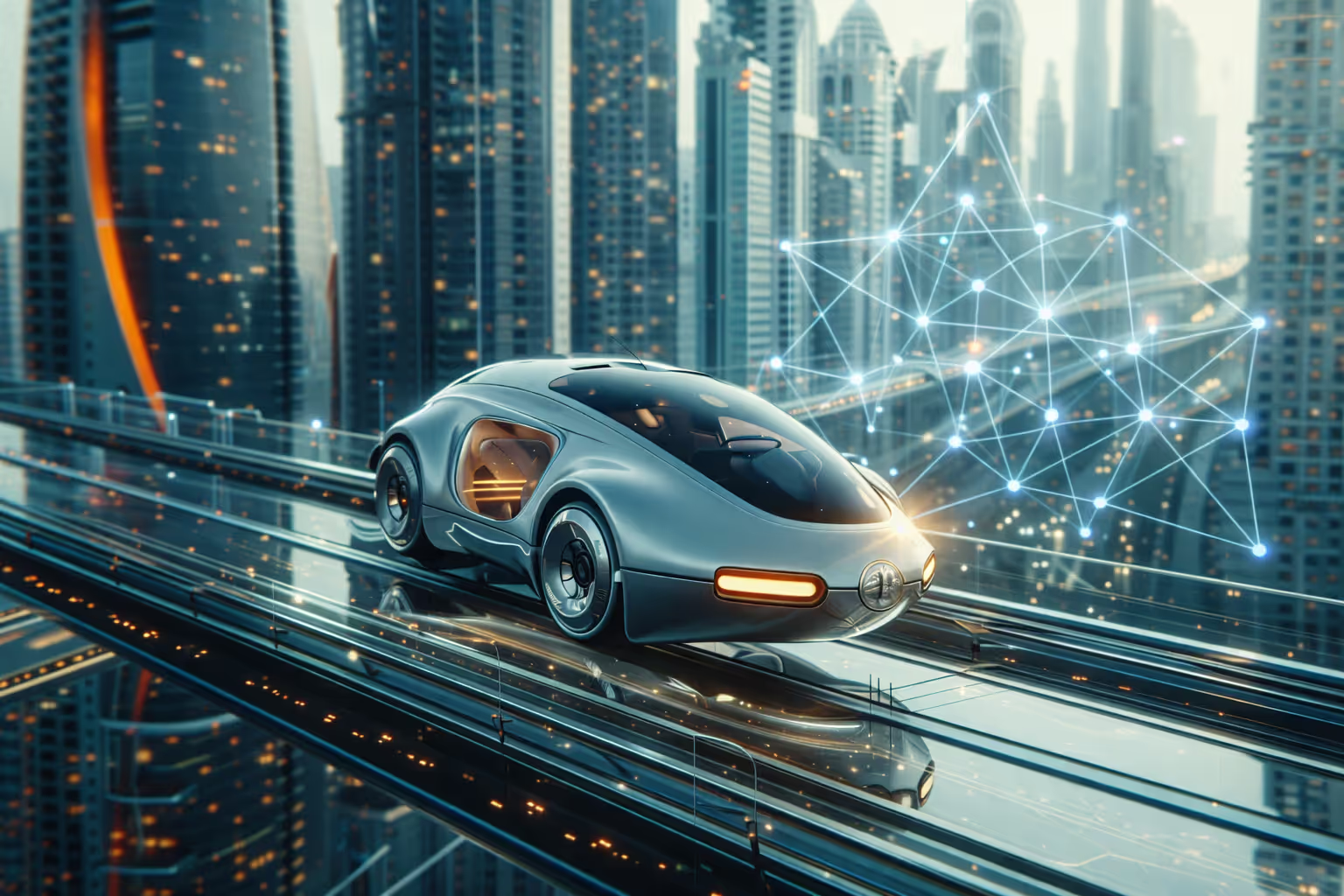
Author: Alex Johnson;
Source: edmmnatsakanyan.com
Predicting the future of self-driving cars is notoriously difficult. The technology has progressed slower than many anticipated a decade ago, and confident predictions have repeatedly proven wrong. Rather than offering predictions, the following presents three plausible scenarios for how the next five to fifteen years might unfold, each with different implications for consumers, cities, jobs, and the insurance and liability landscape.
Scenario One: Gradual Expansion
In this scenario, autonomous technology improves steadily but not dramatically. Robotaxi services expand gradually from current deployment areas to additional carefully mapped urban zones in favorable climates. Autonomous trucking becomes commercially significant on selected highway corridors, particularly in the Sun Belt where weather is predictable. Consumer vehicles continue to gain more capable ADAS features, with Level 2+ systems becoming standard and Level 3 systems appearing in premium vehicles for limited highway use.
- For consumers, this scenario means increasingly helpful driver assistance that makes highway driving easier and potentially safer, but no fundamental change in vehicle ownership or usage patterns. You still own or lease a car; it just has better assist features than your previous one.
- For cities, this scenario means managing limited robotaxi deployments in designated areas, updating infrastructure as needed, but no wholesale transformation of urban transportation. Traffic patterns, parking needs, and transit systems continue roughly as they are.
- For jobs, this scenario means some displacement in long-haul trucking, partially offset by continued driver shortages and by growth in jobs supporting autonomous vehicle operations. Truck driving doesn't disappear, but the mix of routes and requirements shifts.
- For insurance and liability, this scenario involves gradual evolution rather than revolution. The existing framework adapts as data accumulates about ADAS performance and autonomous deployments. Liability questions are addressed case by case as incidents occur and are adjudicated.
Scenario Two: Accelerated Breakthroughs
In this scenario, technical breakthroughs expand autonomous vehicle capabilities faster than currently expected. Perception systems become robust enough to handle diverse weather and road conditions. Planning systems solve the long tail of edge cases more effectively than current approaches suggest. Regulatory frameworks develop to permit broader deployment.
Scenario Three: Extended Plateau
In this scenario, the fundamental difficulty of creating truly robust autonomous driving proves greater than optimists anticipate. Current approaches reach limits that can't be overcome without architectural breakthroughs that haven't yet emerged. Deployment remains limited to favorable conditions, and the promised transformation of transportation remains perpetually five years away.
- For consumers, this scenario means powerful ADAS that makes driving easier but never eliminates the need for human attention and capability. The fully self-driving car remains a promise, not a reality.
- For cities, this scenario involves less disruption but also fewer potential benefits. The hoped-for efficiency gains from shared autonomous fleets don't materialize. Parking needs don't decline. The challenges of urban transportation remain largely the challenges they are today.
- For jobs, this scenario involves less displacement but also continued strain from driver shortages in trucking and challenges in logistics that autonomous systems were supposed to address.
- For insurance and liability, this scenario allows gradual adaptation rather than requiring rapid framework changes. The existing system evolves to accommodate better ADAS, but fundamental questions about autonomous vehicle liability remain largely theoretical
FAQ
Conclusion: The Road Ahead
The future of AI on wheels is neither the science fiction transformation that optimists promise nor the permanent stall that skeptics suggest. The technology is real, it works under defined conditions, and it continues to improve. It also remains far from the fully autonomous cars-that-drive-themselves-anywhere vision that has been promised for decades.
What exists today is impressive: driver assistance systems that make highway driving easier and safer when used appropriately; limited robotaxi services that demonstrate genuine autonomy in favorable conditions; autonomous trucks operating on designated routes. What doesn't exist is the universal self-driving car that eliminates the need for human driving capability, the robotaxi service that works everywhere in all weather, or the technology that has definitively proven safer than attentive human driving across all conditions.
The practical implications for most Americans are straightforward. If you're buying a car today, you can get useful ADAS features that will help on highway driving—but you'll still need to pay attention. If you're in Phoenix or San Francisco, you can hail a robotaxi in certain areas—but you can't rely on it to get you everywhere you need to go. If you're in the trucking industry, you should be watching autonomous developments—but you shouldn't expect human drivers to be replaced on most routes anytime soon.
— Alex Johnson
The longer-term future is genuinely uncertain. The technology might advance faster than expected. It might hit limits that prove harder to overcome than current approaches suggest. The regulatory environment might enable or constrain deployment in ways that shape what's possible. Economic pressures might accelerate adoption in some applications while limiting it in others.
What's certain is that AI in vehicles will continue to develop, that it will increasingly affect how Americans drive and move, and that understanding the technology—its capabilities, its limits, and its implications—matters for anyone navigating roads that are slowly, unevenly, but genuinely becoming more automated. The intersection of artificial intelligence and transportation is not a future event but a present reality, one that will become more significant in the years ahead regardless of which scenario ultimately unfolds.
Related Stories
Read more
Read more


Content on edmmnatsakanyan.com is provided for general informational and educational purposes only. It is not intended to be, and should not be construed as, professional automotive, financial, leasing, or technical advice, nor as a substitute for consultation with qualified professionals.
The information provided on this website is for general informational purposes only and may include content related to cars, luxury vehicle leasing, automotive innovations, electric vehicles, and future mobility technologies. Use of this website does not create a professional, advisory, or client relationship between edmmnatsakanyan.com and the user.
Edmmnatsakanyan.com is not responsible for any errors or omissions, or for actions taken in reliance on the information contained on this website.