
BYD vs Tesla: How a Chinese Battery Company Became the World's Largest EV Maker
BYD vs Tesla: How a Chinese Battery Company Became the World's Largest EV Maker

Imntroduction: The Moment Everything Changed
For more than a decade, one name dominated every conversation about electric vehicles: Tesla. Elon Musk's company didn't just sell cars — it sold a vision of the future, proved the skeptics wrong, and made electric mobility desirable in ways that no one had managed before. To say "Tesla" was to say "electric car" in the same breath, the brand and the category becoming almost synonymous in the public imagination.
That era has ended.
In the fourth quarter of 2024, BYD — a Chinese company that most Western consumers still struggle to pronounce correctly — delivered more battery-electric vehicles than Tesla for the first time in history. The numbers themselves tell only part of the story: BYD shipped over 595,000 pure electric vehicles globally, while Tesla managed approximately 495,000. But numbers, however stark, cannot capture what this moment truly represents.
This is not merely a reshuffling of corporate rankings. This is a fundamental realignment of global industrial power, the kind that happens perhaps once in a generation. The automotive industry — born in Germany, perfected in America, challenged by Japan — now faces its most profound transformation since Henry Ford's assembly line. And at the center of this transformation stands a company that, just fifteen years ago, was primarily known for making cell phone batteries.
The implications ripple far beyond shareholder returns and market capitalization. They touch geopolitics and trade policy, environmental progress and technological development, the future of work and the shape of cities. When we look back at this moment decades from now, we may well see it as the point when the center of gravity in global manufacturing shifted decisively eastward — not through military conquest or political revolution, but through relentless execution in an industry that the West had assumed it would always dominate.
Understanding how we arrived at this moment requires understanding both companies — their origins, their strategies, their strengths and weaknesses. It requires understanding the policy environments that shaped their growth and the technological bets that defined their trajectories. Most importantly, it requires understanding what this shift means for everyone who will buy, drive, or simply share the road with electric vehicles in the decades to come.
The Rise of BYD: From Batteries to Global Dominance
The story of BYD — "Build Your Dreams" in its optimistic English rendering — begins not with automobiles but with chemistry. Wang Chuanfu, the company's founder, earned his expertise in battery technology as a government researcher before striking out on his own in 1995. His initial business plan was modest by today's standards: manufacture rechargeable batteries for mobile phones and other consumer electronics, competing on cost with Japanese incumbents who then dominated the market.
This origin matters enormously for understanding BYD's current success. While other automakers approached electric vehicles as a new challenge requiring new capabilities, BYD approached automobiles as a new application for capabilities it had already mastered. The battery — the most expensive, most complex, and most strategically important component of any electric vehicle — was not a problem for BYD to solve. It was the foundation upon which everything else would be built.
Wang's decision to enter the automotive industry in 2003 struck many observers as foolhardy. BYD acquired a struggling state-owned car manufacturer with aging facilities and limited brand recognition. The Chinese automotive market was growing rapidly, but it was dominated by joint ventures between Chinese companies and established global players — Volkswagen, Toyota, General Motors. What could a battery company possibly contribute to this crowded, competitive landscape?
The answer emerged slowly at first, then all at once. BYD's early vehicles were unremarkable — competent but uninspiring sedans and hatchbacks that competed primarily on price. But beneath these conventional exteriors, something revolutionary was taking shape. BYD was building not just cars but an entirely new kind of automotive company, one that controlled virtually every aspect of vehicle production from raw materials to finished product.
The Vertical Integration Advantage
Most global automakers operate as assemblers. They design vehicles, then contract with hundreds or thousands of suppliers to produce the components — engines from one company, transmissions from another, electronics from a third, seats from a fourth. This model offers flexibility and allows automakers to focus on their core competencies of design, marketing, and final assembly. But it also creates dependencies, adds costs at each transaction, and limits control over quality and innovation.
BYD chose a radically different path. Today, the company manufactures virtually everything in-house:
- Battery cells and packs — the Blade Battery technology that defines BYD's competitive edge
- Electric motors and power electronics — the drivetrain components that determine vehicle performance
- Semiconductors and chips — the critical components that caused industry-wide shortages in 2021-2022
- Vehicle bodies, chassis, and interiors — traditional automotive manufacturing at massive scale
- Manufacturing equipment — even the machines that build the machines
The Compounding Effect: Every component produced in-house eliminates a supplier's profit margin. Every technology developed internally remains proprietary. Every engineering challenge spans the full system rather than stopping at component boundaries.
— Alex Johnson
The benefits became starkly visible during the global semiconductor shortage that crippled the automotive industry in 2021-2022. While Toyota, Ford, and General Motors idled factories for lack of chips, BYD's in-house semiconductor division kept production lines running. The company not only maintained output but actually increased it, gaining market share while competitors struggled with empty dealer lots and frustrated customers.
The Blade Battery Revolution
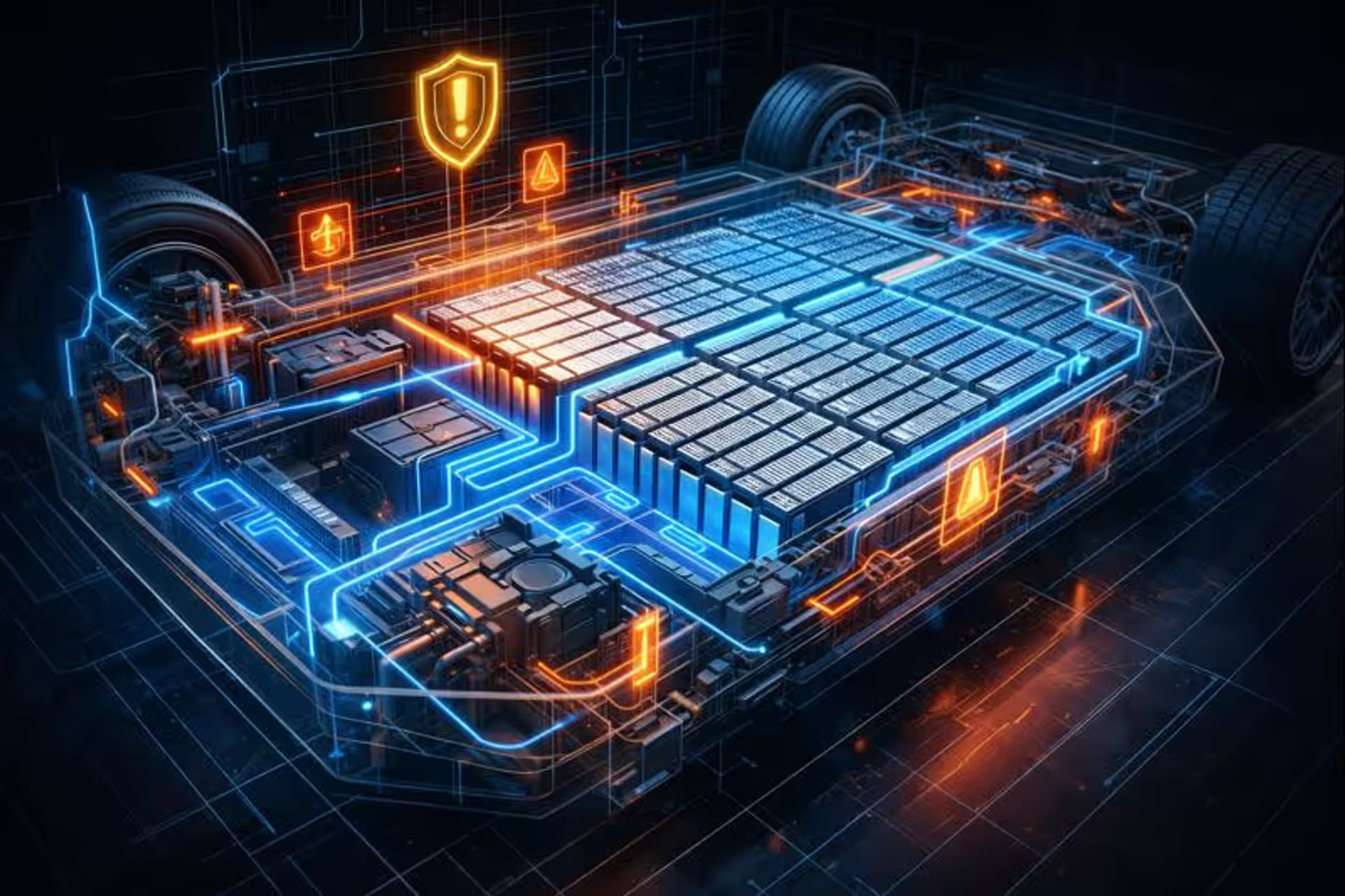
If vertical integration provided BYD's strategic foundation, the Blade Batteryprovided its technological breakthrough. Introduced in 2020, this lithium iron phosphate (LFP) cell design challenged assumptions that had guided battery development for years.
The dominant battery chemistry for electric vehicles had been nickel-manganese-cobalt (NMC), which offers high energy density — more range per kilogram of battery weight. But NMC batteries carry significant downsides: they're expensive, they depend on cobalt (a mineral with troubled supply chains and ethical concerns), and they're prone to thermal runaway — the cascading chemical reaction that causes battery fires.
BYD's Blade Battery uses lithium iron phosphate chemistry, which had traditionally been dismissed for vehicle applications due to lower energy density. Wang Chuanfu's engineers solved this problem through innovative packaging. By reshaping cells into long, thin "blades" and arranging them directly into the battery pack without intermediate modules, they achieved energy density competitive with NMC while retaining LFP's inherent advantages.
Those advantages proved substantial:
- Safety: The Blade Battery passed the infamous "nail penetration test" — a brutal evaluation where a steel nail is driven through a fully charged cell — without catching fire or even smoking significantly
- Longevity: The chemistry supports more charge cycles than NMC alternatives, with BYD claiming vehicle lifespans exceeding 1.2 million kilometers
- Cost: Iron and phosphate are abundant and inexpensive compared to nickel and cobalt, reducing both production costs and supply chain risks
- Stability: No thermal runaway risk means simpler cooling systems and lighter overall pack weight
Market Validation: Tesla's subsequent decision to adopt LFP batteries in its lower-priced vehicles represented a quiet acknowledgment of BYD's approach. The American company now sources LFP cells from Chinese suppliers — including, by some accounts, from BYD itself.
— Alex Johnson
Author: Alex Johnson;
Source: edmmnatsakanyan.com
Why BYD Overtook Tesla: Understanding the Shift
The question everyone asks — "How did BYD beat Tesla?" — implies a simple answer, a single cause that explains the outcome. Reality is messier. BYD's rise to the top of global EV sales reflects the convergence of multiple factors, each insufficient alone but devastating in combination.
The Product Range Question
Tesla's product strategy has always emphasized focus. Four core models — the Model S and X for the luxury market, the Model 3 and Y for the mainstream — cover a deliberately limited range. Elon Musk has argued that this focus enables manufacturing efficiency and engineering excellence. Why dilute resources across a dozen models when you can perfect a few?
BYD asked a different question: Why limit yourself to customers who can afford $40,000 or more for a car?
Today, BYD offers more than twenty distinct vehicle models spanning every conceivable price point and body style. The Seagull, a compact city car, sells for under $10,000 in China — less than many used Corollas fetch in America. The Dolphin and Seal compete in the mainstream segments where Tesla's Model 3 and Y operate. The Han and Tang offer luxury and space. And through sub-brands like Denza, Yangwang, and Fangchengbao, BYD reaches into premium segments with vehicles priced above $100,000.
This breadth matters because car buying is not purely rational. A customer who cannot afford a Model Y doesn't simply wait until they can; they buy something else. If BYD offers that something else — a Dolphin at half the Model Y's price — the customer enters the BYD ecosystem. When their circumstances improve, they consider upgrading to a Seal or Han rather than switching to Tesla. Brand loyalty compounds, and Tesla never gets the chance to compete for that customer at all.
The numbers tell the story clearly. In China, BYD sells approximately five vehicles for every one that Tesla sells. This ratio reflects not superior engineering or better marketing but simply the mathematical reality that more people can afford $15,000 cars than $40,000 cars. Tesla has acknowledged this gap implicitly by promising an affordable model for years — but that promise remains unfulfilled while BYD floods the market with options at every price point.
The Plug-In Hybrid Strategy
A crucial distinction shapes how we interpret BYD's victory: the company counts both battery-electric vehicles and plug-in hybrids in its sales figures. Tesla sells only pure battery-electric vehicles and always has.
This distinction matters philosophically and practically. Plug-in hybrids retain gasoline engines alongside their electric motors and batteries. They can travel 60-120 kilometers on electricity alone — sufficient for most daily driving — then switch to gasoline for longer trips. For consumers worried about charging infrastructure, range anxiety, or the total commitment that a pure electric vehicle represents, plug-in hybrids offer a transitional path.
BYD recognized early that this transition product would find enormous demand, especially outside wealthy urban centers where charging infrastructure remains sparse. Its DM-i (Dual Mode intelligence) system delivers impressive electric-only range, exceptional fuel efficiency when the gasoline engine engages, and prices lower than equivalent battery-electric models. For many Chinese consumers, especially those in smaller cities or rural areas, these plug-in hybrids represent the rational choice — more practical than pure electric, more economical than conventional gasoline cars.
Of BYD's 4.2 million new energy vehicle sales in 2024, roughly 2.4 million were plug-in hybrids. Tesla sold zero vehicles in this category. One can argue about whether plug-in hybrids should "count" as electric vehicles — they do still burn gasoline, after all — but the market has rendered its verdict. Consumers want these vehicles, BYD provides them, and the sales numbers reflect that reality.
Tesla's purity on this question has ideological appeal and environmental merit. But it also cedes an enormous market segment to competitors willing to meet customers where they are rather than where Tesla believes they should be.
China: The Market That Decided Everything
China represents approximately 60% of global electric vehicle sales. Whoever wins China wins the world, at least for now. And in China, BYD doesn't just win — it dominates with an intensity that leaves foreign competitors struggling for scraps.
BYD commands roughly 35% of China's new energy vehicle market. Tesla holds perhaps 7-8%. The remaining half-plus splits among dozens of Chinese brands, with foreign manufacturers collectively holding less than 10%. These numbers would have seemed impossible a decade ago, when Chinese consumers aspired to foreign brands and viewed domestic options with skepticism. Today, the dynamics have reversed: Chinese brands lead in technology, design, and consumer preference, while foreign brands struggle to justify premium prices for products that often lag in features.
The reasons for BYD's Chinese dominance interweave culture, policy, and capability. Government encouragement of domestic brands — through procurement preferences, regulatory advantages, and sustained policy support — created conditions for Chinese companies to thrive. Consumer nationalism, heightened by geopolitical tensions, increased willingness to "buy Chinese" even absent price advantages. And BYD's relentless improvement in quality, technology, and design eliminated the traditional arguments for choosing foreign alternatives.
Tesla's Shanghai factory produces vehicles competitive with anything BYD offers. The company has invested heavily in the Chinese market and maintains significant brand prestige, especially among affluent urban consumers. But Tesla fights with one hand tied behind its back: it cannot match BYD's price points, cannot match BYD's dealer network reaching into smaller cities, and cannot match BYD's product range serving diverse customer needs. Every Tesla sold in China represents a minor victory; every BYD sold represents the natural order of a market that has tilted decisively toward domestic champions.
Tesla's Challenges: What Changed?
Understanding BYD's rise requires understanding Tesla's struggles — not because Tesla has failed in any absolute sense, but because the conditions that enabled Tesla's dominance have shifted in ways that favor different capabilities.
The Innovation Plateau
Tesla's early success rested on category-defining innovation. The Model S proved that electric vehicles could be genuinely desirable — fast, beautiful, and prestigious rather than merely virtuous. The Supercharger network solved the charging infrastructure problem that had hobbled previous EV efforts. Autopilot pioneered driver assistance features that made every other car feel primitive. Over-the-air updates transformed the very concept of what a car could be, improving and expanding capabilities years after purchase.
These innovations earned Tesla a lead that seemed insurmountable. But innovation advantages erode without constant replenishment, and Tesla's pace of breakthrough innovation has slowed notably in recent years.
The product pipeline tells the story:
| Model | Launch Year | Status |
| Model 3 | 2017 | Aging, minor refresh in 2023 |
| Model Y | 2020 | Still the bestseller, but competitors closing gap |
| Cybertruck | 2023 | Polarizing design, limited volume |
| Affordable Tesla | "Coming soon" | Repeatedly delayed since 2020 |
| Next-gen Roadster | Announced 2017 | Still not in production |
| Semi | 2022 (limited) | Niche commercial market only |
The Narrowing Gap: Modern electric vehicles from Hyundai, Kia, BMW, Mercedes, and numerous Chinese brands now offer comparable range, competitive performance, and features that Tesla either lacks or pioneered long enough ago that they've become industry standard.
— Alex Johnson
Full Self-Driving exemplifies the challenge. Promised as imminent since 2016, true autonomous driving remains elusive. Tesla's approach — vision-only systems trained on vast datasets from customer vehicles — has produced impressive demonstrations and genuine utility in certain conditions, but the jump from Level 2 driver assistance to genuine autonomy has proven far more difficult than Musk's optimistic timelines suggested. Customers who paid thousands for FSD capability years ago still wait for the features they were promised.
Brand and Leadership Complications
Elon Musk built Tesla through force of will, technical vision, and an ability to generate attention that most companies could never match. For years, his celebrity served as Tesla's most powerful marketing asset — free publicity, devoted fans, and a sense that buying a Tesla meant buying into a vision of the future personally championed by the world's most famous entrepreneur.
That dynamic has grown more complicated. Musk's acquisition of Twitter (now X), his increasingly vocal political commentary, and his divisive public persona have transformed him from asset to liability for some customer segments. The environmentally conscious early adopters who drove Tesla's initial success often hold political views that Musk now regularly antagonizes. Brand perception surveys show growing ambivalence, with admiration for Tesla's products increasingly decoupled from — or undermined by — feelings about its CEO.
Quality concerns that plagued Tesla's early production have proven stubbornly persistent. Panel gaps, paint imperfections, and fit-and-finish issues that would be unacceptable from legacy luxury brands continue appearing in customer vehicles. The service network, though improved, still struggles with capacity that lags sales volume. For customers accustomed to the ownership experience provided by established luxury brands, Tesla can feel like a technology company that happens to make cars rather than a car company that happens to use technology.
None of these factors alone explains Tesla's relative decline. Together, they create conditions where BYD's advantages — cost structure, market coverage, product range — can translate into market share gains that would have been unthinkable when Tesla stood alone in a category it had essentially created.
The Global Subsidy Landscape
No understanding of the EV market is complete without understanding the policies that shape it. Electric vehicles remain more expensive than gasoline equivalents, and without government support, adoption would proceed far more slowly. The nature, generosity, and conditions of that support vary dramatically across markets — and those variations have profound competitive implications.
America's Complicated Incentives
The United States has never achieved policy consensus on electric vehicles. Support fluctuates with administrations, programs change with congressional composition, and the complicated federal structure creates a patchwork of state and local incentives that vary enormously by geography.
The Inflation Reduction Act of 2022 represented the most significant federal commitment to EV support in American history, but it came with strings attached. The $7,500 federal tax credit now requires vehicles to be assembled in North America, with escalating requirements for battery component and critical mineral sourcing that exclude many Chinese suppliers. Price caps limit eligibility to vehicles under $55,000 for sedans and $80,000 for SUVs. Income limits exclude higher earners entirely.
These requirements serve legitimate policy goals: building domestic manufacturing capacity, reducing dependence on Chinese supply chains, ensuring subsidies benefit middle-class buyers rather than wealthy early adopters. But they also create complications for Tesla, whose supply chain relationships with Chinese battery suppliers now present compliance challenges. Some Model 3 variants have lost full credit eligibility. Price cuts needed to stay within caps have compressed margins.
More significantly, the policy environment has created barriers to Chinese EVs that effectively exclude them from the American market entirely. Proposed tariffs of 100% on Chinese-made vehicles would make even BYD's inexpensive models uncompetitive. Battery sourcing requirements exclude Chinese suppliers from subsidized vehicles. The message is clear: America will subsidize electric vehicles, but not Chinese electric vehicles.
This protection may benefit American and allied manufacturers in the short term. But it also means American consumers pay more for less choice, and American companies face less competitive pressure to improve. The disconnect between American and global EV markets will likely widen, with uncertain long-term consequences.
Europe's Retreat and China's Strategy
European EV markets developed rapidly under generous subsidy regimes, then stumbled when those subsidies disappeared. Germany's abrupt termination of its €4,500-€6,000 EV bonus in December 2023 — announced suddenly, without phase-out period — sent sales tumbling. Buyers who had planned purchases around expected subsidies either rushed to complete transactions or abandoned plans entirely. The market has yet to recover its previous trajectory.
Other European nations maintain support programs of varying generosity, but the trend points toward subsidy reduction. Budget constraints, competing priorities, and growing EV market share all reduce political appetite for continued support. The coming years will test whether European consumers will buy electric vehicles without financial incentives, or whether the transition depends on continued policy support that governments increasingly struggle to justify.
China's approach differs fundamentally. Having invested heavily in building domestic EV capabilities through the industry's formative years, China has largely phased out direct consumer subsidies. But support continues through other channels: government procurement of domestic vehicles, regulatory advantages for local brands, export financing for manufacturers expanding globally, and sustained investment in charging infrastructure.
The strategic logic is clear. China seeks to dominate the global EV industry as it has dominated solar panels, batteries, and consumer electronics — through manufacturing scale, cost advantages, and relentless improvement that eventually renders competition futile. BYD's rise is not accident or anomaly; it is the intended outcome of a decades-long industrial strategy now reaching fruition.
[content]
The Competitive Response
The shift in EV leadership has forced responses across the industry. Legacy automakers, once dismissive of electric vehicles, now scramble to transform themselves. Tesla, once the unquestioned leader, must defend a position it had assumed was secure. And Chinese manufacturers beyond BYD look at the global market with ambitions of their own.
Legacy Automakers Accelerate
The traditional automotive giants have responded to the EV revolution with varying degrees of success and commitment:
| Manufacturer | Investment | Key Strategy | Current Status |
| Volkswagen Group | €180 billion through 2030 | Dedicated EV platforms (MEB, PPE) | Struggling in China, moderate success in Europe |
| General Motors | $35 billion through 2025 | Ultium platform across brands | Delayed targets, focus shifted to profitability |
| Ford | $50 billion through 2026 | Mustang Mach-E, F-150 Lightning | EV division losses exceeded $4 billion |
| Hyundai-Kia | $28 billion through 2030 | E-GMP platform, 800V architecture | Most successful traditional OEM in EVs |
Volkswagen's challenge is less technological than organizational: transforming a century-old company optimized for internal combustion into one competitive in an electric future requires cultural change that cannot be purchased regardless of budget.
General Motors and Ford have announced ambitious EV investments, then retreated when early returns disappointed. Both companies have delayed volume targets, reduced spending plans, and acknowledged that the transition will take longer and cost more than initially projected.
The Korean Exception: Hyundai and Kia have emerged as perhaps the most successful traditional automakers in the EV transition. Their dedicated E-GMP platform, 800-volt electrical architecture, and aggressive global expansion have positioned them as credible alternatives to both Tesla and Chinese competitors.
— Alex Johnson
Chinese Brands Go Global
BYD's success has inspired other Chinese manufacturers to pursue international expansion:
- MG (SAIC) — Trading on nostalgic British heritage, established meaningful presence in Europe, UK, and Australia through aggressive value pricing
- NIO — Pursuing premium positioning with battery swap technology, expanding cautiously into European markets
- XPeng — Technology-focused approach competing directly with Tesla on autonomy features
- Great Wall, Chery, GAC — Following with varying strategies, targeting value-conscious consumers
The path forward is challenging. Tariff barriers in America and potentially Europe create significant obstacles. Service network establishment requires substantial investment and time. Brand awareness must be built from zero in markets where Chinese automotive brands carry no recognition or, worse, assumptions of inferior quality rooted in outdated perceptions.
Yet the trajectory seems clear. Chinese EVs offer combinations of price, features, and technology that established competitors struggle to match. If tariff barriers prevent Chinese-made vehicles from reaching certain markets, Chinese manufacturers will build factories in those markets — as BYD is doing in Hungary, Thailand, and Brazil. The question is not whether Chinese EVs will achieve global presence, but how quickly and through which paths.
What This Means for the Future
The shift from Tesla to BYD leadership marks not an ending but a transition. The implications will unfold over years and decades, shaping markets, industries, and geopolitical relationships in ways we can only partially anticipate.
The Near-Term Outlook
The next two to three years will likely see continued BYD expansion and intensifying competitive pressure across all markets. BYD's production capacity continues growing; new factories in multiple countries will enable local production that circumvents trade barriers. The product pipeline remains full, with new models targeting segments where BYD currently lacks presence.
Tesla faces a critical period. The promised affordable model, if it materializes, could reinvigorate growth by accessing market segments where Tesla has never competed. Continued FSD development could eventually deliver the autonomous capabilities that Musk has promised, creating new revenue streams and competitive advantages. But delays in either area extend the period of vulnerability, allowing competitors to strengthen positions that become increasingly difficult to dislodge.
The price war that has characterized the past two years shows no signs of ending. BYD's cost structure enables profitable operation at prices that squeeze competitors' margins to zero or below. Traditional automakers bleeding cash on EV operations must decide how long to sustain losses in pursuit of eventual scale. Startups without BYD's cost advantages or Tesla's brand power face existential pressure; consolidation and failures seem inevitable.
Author: Alex Johnson;
Source: edmmnatsakanyan.com
The Longer View
Looking further ahead, several dynamics will shape the industry's evolution. Battery technology continues advancing; solid-state batteries promise improved safety, faster charging, and reduced costs, though commercial deployment timelines remain uncertain. Autonomous driving technology matures incrementally, with eventual impacts on vehicle design, ownership models, and transportation systems that remain difficult to predict.
The competitive landscape will likely consolidate around a smaller number of major players. The era of dozens of EV startups, each promising to be the next Tesla, is ending. Capital has grown scarce for companies burning cash without clear paths to profitability. Those that survive will do so through acquisition, niche focus, or improbable breakthroughs. The mass market will be served by companies with manufacturing scale, supply chain control, and balance sheets strong enough to sustain the losses inherent in building new automotive businesses.
China's position in the global automotive industry will strengthen regardless of trade barriers. The manufacturing ecosystem, supplier base, and engineering talent concentrated there represent advantages that cannot be quickly replicated elsewhere. Western companies may succeed in limiting Chinese vehicle imports, but they cannot easily replicate Chinese costs or access Chinese innovations without Chinese partnerships.
What This Means for Car Buyers
For consumers considering electric vehicles, the leadership shift between BYD and Tesla carries practical implications worth understanding.
| Factor | BYD Advantages | Tesla Advantages |
| Pricing | Lower prices across all segments | Premium positioning, strong resale |
| Model Range | 20+ models, every price point | Limited but focused lineup |
| Battery Technology | Blade Battery safety and longevity | Proven performance and reliability |
| Charging Network | Relies on public infrastructure | Supercharger network, industry-leading |
| Software/Updates | Improving rapidly | Established OTA update ecosystem |
| Service Network | Developing in new markets | Established but capacity-constrained |
| Availability | Limited outside Asia currently | Global presence and production |
| Brand Recognition | Building in Western markets | Dominant EV brand awareness |
The practical reality for most Western consumers is that BYD vehicles remain difficult or impossible to purchase. American buyers face effective barriers that exclude Chinese EVs entirely. European buyers have more access but limited model availability and developing service networks. For these consumers, the BYD-Tesla competition matters primarily through its effects on pricing and innovation rather than through direct purchase decisions.
In markets where BYD is available — Australia, Southeast Asia, Latin America, and increasingly Europe — buyers face genuine choices. BYD vehicles offer exceptional value, proven technology, and features competitive with or exceeding alternatives at similar prices. Tesla vehicles offer the Supercharger network, established resale values, and brand prestige that Chinese competitors have not yet matched. The right choice depends on individual priorities, driving patterns, and willingness to adopt brands without long track records in local markets.
Leasing deserves particular consideration in this rapidly evolving market. The uncertainties surrounding technology development, competitive dynamics, and residual values make long-term ownership commitments riskier than usual. Leasing allows access to current technology while preserving flexibility to switch as the market evolves. When the lease term ends, the landscape may look dramatically different — and the option to choose again based on new information carries real value.
Conclusion: The Revolution Continues
The electric vehicle revolution has not ended with BYD's rise to leadership. If anything, it has entered its most consequential phase — the transition from early adoption to mass market, from novelty to normalcy, from question to established answer.
Tesla's contribution to this transformation cannot be overstated. Without Tesla proving that electric vehicles could be desirable, the market that BYD now leads might not exist. Elon Musk's vision, risk-taking, and relentless execution created conditions for an entire industry to flourish. That BYD has now surpassed Tesla in sales reflects not Tesla's failure but the success of the broader transformation Tesla enabled.
BYD's ascendance reflects something equally important: the emergence of China as a serious competitor in industries that the West long assumed it would dominate. The automotive industry, born in Germany and America, perfected through a century of innovation by companies whose names became synonymous with industrial excellence, now sees its future increasingly shaped by a company from Shenzhen. This shift will reverberate through trade policy, international relations, and economic strategy for decades to come.
The Environmental Equation
The competition between BYD and Tesla carries implications beyond market share and corporate profits. Electric vehicle adoption represents one of humanity's most significant opportunities to reduce transportation emissions — and the pace of that adoption depends heavily on competitive dynamics.
BYD's aggressive pricing makes EVs accessible to consumers who could never afford a Tesla. The Seagull at $10,000 opens electric mobility to demographics that premium manufacturers never targeted. Each vehicle sold replaces years of gasoline consumption with electric miles that, depending on grid composition, produce dramatically fewer emissions. By expanding the total addressable market for EVs, BYD accelerates the transition even as it captures share from competitors.
The math is stark. Transportation accounts for roughly 15% of global greenhouse gas emissions. Each electric vehicle replacing an internal combustion equivalent saves an average of 4.6 metric tons of CO2 annually. Multiply by millions of vehicles, and the numbers become significant at planetary scale. BYD's 4+ million annual sales translate to roughly 18 million tons of avoided emissions yearly. Add Tesla's contribution, add other manufacturers, and the collective impact grows substantial.
Critics rightly note complications. Battery production generates significant emissions, particularly when manufacturing relies on coal-powered electricity. Mining lithium, cobalt, and nickel creates environmental and social challenges. Battery recycling infrastructure remains underdeveloped. These concerns are real and deserve continued attention.
Yet lifecycle analyses consistently demonstrate that electric vehicles produce fewer total emissions than gasoline equivalents, even accounting for manufacturing and assuming average grid composition. As grids decarbonize — a transition accelerating globally — the advantage grows. The competition driving EV adoption faster benefits the climate regardless of which company leads the sales charts.
Lessons and Questions
Several lessons emerge from this historic shift, applicable beyond the automotive industry:
First, vertical integration provides strategic advantages that market-based supplier relationships cannot match. BYD's control of its supply chain — from battery chemistry to semiconductor fabrication — enables cost structures and innovation speeds impossible for competitors dependent on external partners. Industries beyond automotive may find similar logic compelling as supply chain disruptions become more common and more costly.
Second, market coverage matters as much as market leadership. Tesla's focus on premium segments enabled profitability and brand positioning but ceded enormous volume to competitors willing to serve less affluent customers. The billions of consumers in developing economies who cannot afford $40,000 vehicles represent the industry's growth frontier; companies unable or unwilling to serve them will find their leadership positions increasingly nominal.
Third, government policy shapes markets in ways that pure market competition cannot override. China's sustained support for domestic EV capabilities created conditions for BYD's rise. American policy responses may successfully limit Chinese penetration of the US market but cannot reverse the capabilities that Chinese companies have built. Industrial policy, long dismissed in some Western economic traditions, has proven decisive in determining which countries and companies lead strategic industries.
Questions remain that only time will answer. Can Tesla reinvent itself as a mass-market manufacturer, or will it remain a premium brand as larger competitors capture volume? Will Western automakers successfully transform their operations for the electric era, or will the transition prove fatal for some household names? How will trade policy evolve as Chinese EV exports grow and Western manufacturing jobs come under pressure? What unexpected technologies or business models might disrupt assumptions that currently seem solid?
For consumers, the news is largely positive. Competition drives innovation and reduces prices. The BYD-Tesla rivalry, joined by Korean, European, and other Chinese competitors, ensures that electric vehicles will become better and more affordable faster than any single company could achieve alone. The cars available today would have seemed impossible a decade ago; the cars available a decade from now will make today's seem primitive.
The question of who leads the industry matters less than the certainty that the industry will continue advancing. Electric vehicles will displace gasoline cars not because governments mandate it or environmentalists demand it, but because they will become unambiguously better — cheaper to own, easier to operate, and more capable than anything burning fossil fuels can match.
That future is no longer speculative. It is arriving now, shaped by competition between companies and countries, driven by technology and economics, and delivering to consumers vehicles that our parents could scarcely have imagined.
The revolution continues. BYD leads for now. The road ahead remains long, uncertain, and full of possibility.
Related Stories
Read more


Content on edmmnatsakanyan.com is provided for general informational and educational purposes only. It is not intended to be, and should not be construed as, professional automotive, financial, leasing, or technical advice, nor as a substitute for consultation with qualified professionals.
The information provided on this website is for general informational purposes only and may include content related to cars, luxury vehicle leasing, automotive innovations, electric vehicles, and future mobility technologies. Use of this website does not create a professional, advisory, or client relationship between edmmnatsakanyan.com and the user.
Edmmnatsakanyan.com is not responsible for any errors or omissions, or for actions taken in reliance on the information contained on this website.