
Electric Vehicles Explained: Top EV Models, Battery Technology, Autonomous Driving, and What to Buy
Electric Vehicles Explained: Top EV Models, Battery Technology, Autonomous Driving, and What to Buy

Content
Content
Introduction: Standing at the Threshold of the Greatest Transformation in Automotive History
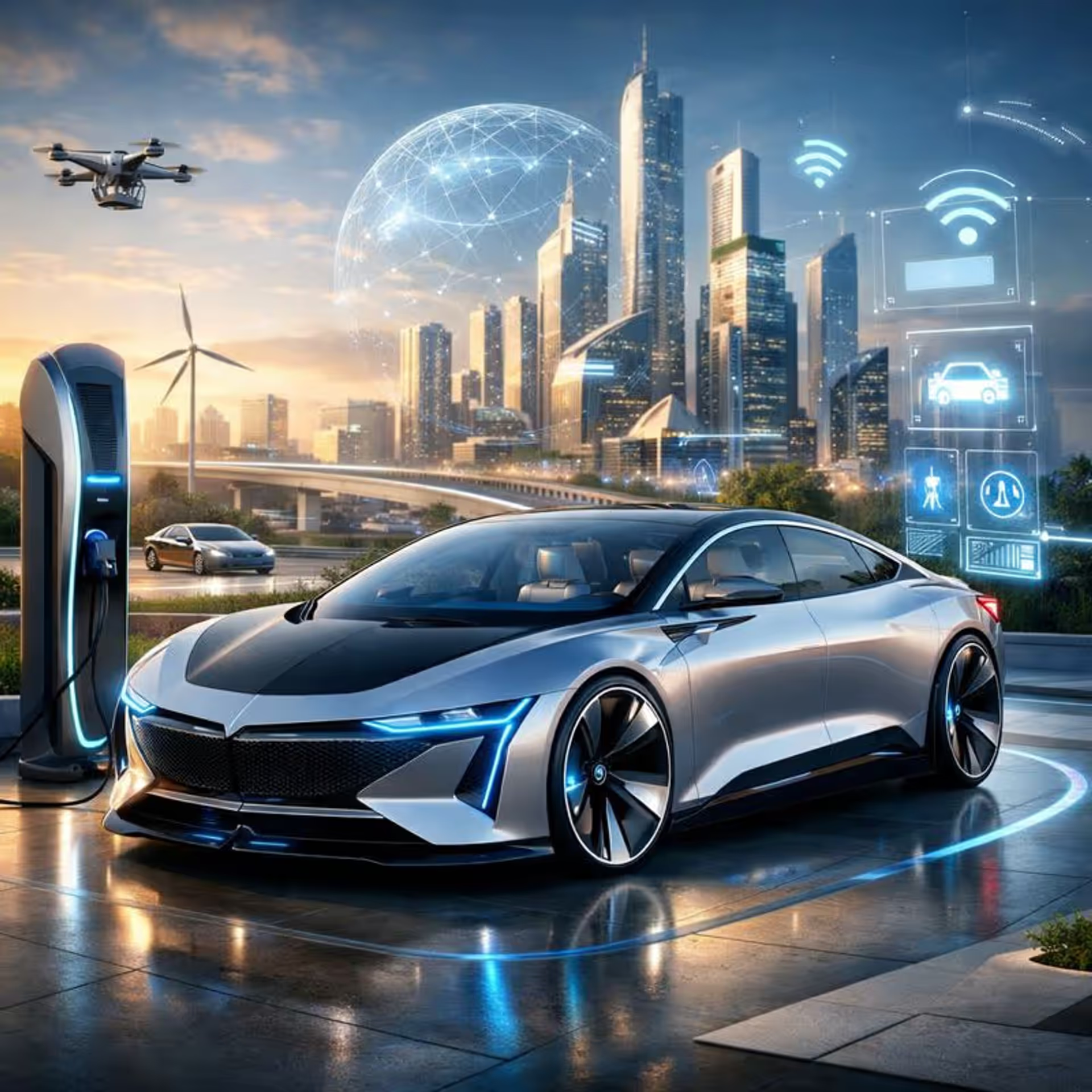
The automotive industry is experiencing a period of unprecedented change. What seemed like science fiction just a decade ago has become everyday reality: electric vehicles with ranges exceeding 450 miles, Level 4 autonomous driving systems, artificial intelligence capable of anticipating driver intentions, and vehicles communicating with each other and urban infrastructure in real-time.
Whether you're searching for the best electric car for families, comparing Tesla vs BMW electric vehicles, or exploring luxury EV lease options, this comprehensive guide covers everything you need to know about automotive technology in 2025.
We stand at the threshold of a fundamental reassessment of the very concept of the automobile. The vehicle is ceasing to be merely a mechanism for moving from point A to point B — it is transforming into an intelligent platform, a personal space, an element of a global digital ecosystem. The car of the future knows its owner better than they know themselves, anticipates needs, adapts to mood and condition, and continuously learns and improves.
This transformation affects not only technology but also business models, consumer expectations, urbanism, and the very fabric of modern society. Automakers with century-long histories are forced to reinvent themselves, technology giants are breaking into the traditional industry, and startups are challenging established players. The boundaries between automotive, technology, and energy sectors are blurring, creating a new convergent mobility ecosystem.
The changes we are witnessing today will define the face of transportation for generations to come. The internal combustion engine, which has dominated for over a century, is gradually giving way to zero-emission electric powertrains. The driver, who has always been central to the driving experience, is becoming an optional participant in the process. Vehicle ownership, traditionally a symbol of freedom and status, is evolving into flexible mobility services.
Key Insight: We are at the epicenter of the greatest technological revolution since the invention of the internal combustion engine. The next decade will define the face of transportation for a century to come.
— Alex Johnson
According to forecasts from leading analytical agencies, by 2030, more than 60% of all new cars sold in developed countries will be fully electric. The autonomous vehicle market will reach the $2 trillion mark, and the concept of car ownership will transform in favor of flexible mobility models, including premium car leasing and subscription services.
In this comprehensive guide, we will analyze the key technological trends shaping the future of electric cars, examine breakthrough innovations from leading manufacturers like Tesla, Mercedes-Benz, BMW, Audi, and Porsche, and assess how these changes will affect car choices for those who value cutting-edge technology, comfort, and status.
Electrification — The Foundation of a New Era in Automotive Engineering
The Revolution in EV Battery Technology: Longest Range Electric Cars
Electric vehicles have come a long way from experimental concepts with limited range to full-fledged flagships of the automotive market. At the heart of this transformation lies the evolution of energy storage technologies — the key to achieving the longest range electric cars on the market today.
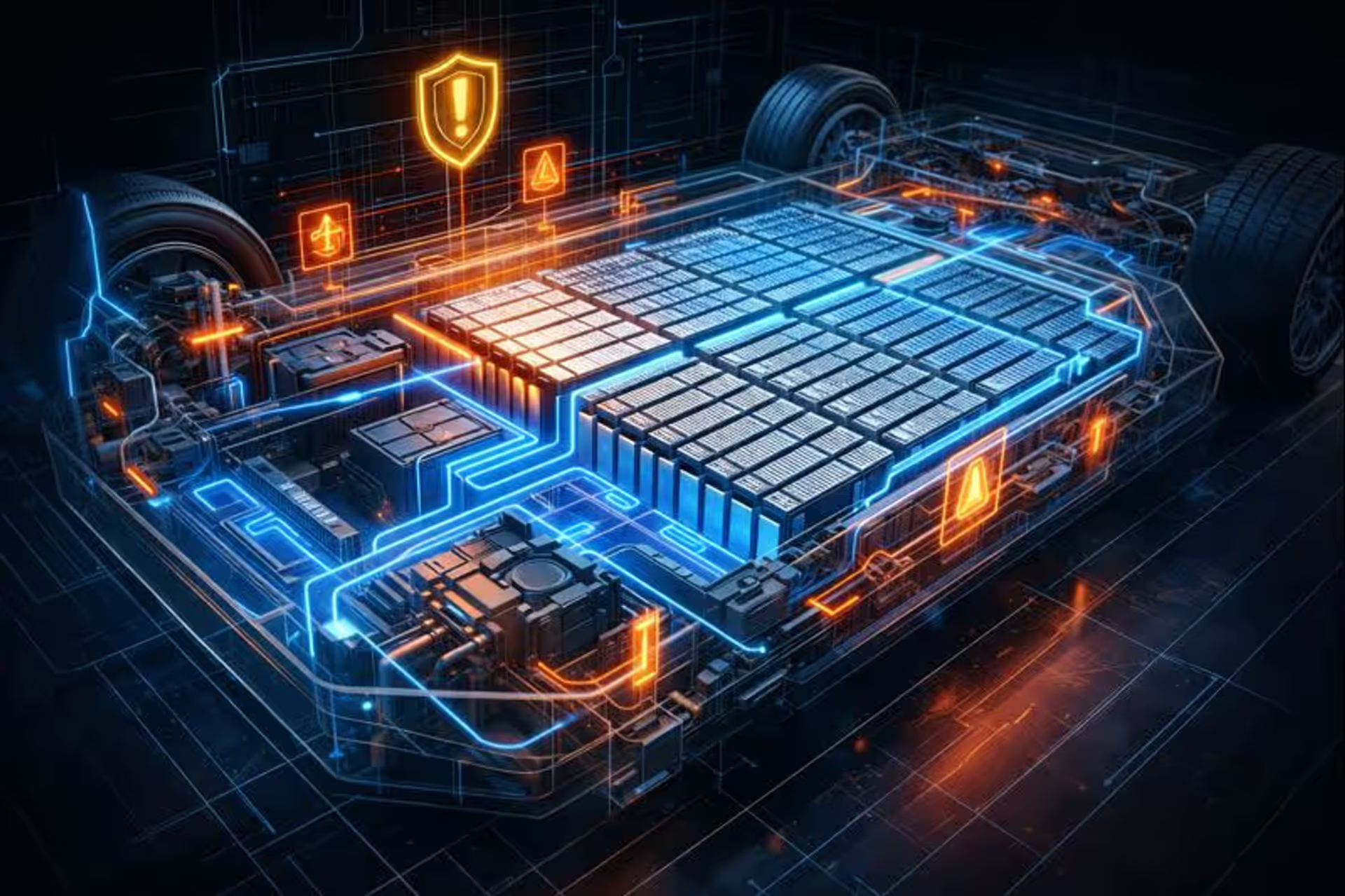
Modern lithium-ion batteries have achieved energy density levels that were considered unattainable just five years ago. Leading manufacturers such as CATL, BYD, Panasonic, and LG Energy Solution are developing cells with energy densities exceeding 300 Wh/kg, providing EV ranges of over 400 miles while maintaining reasonable battery pack weight.
The pace of progress is staggering. Electric car battery costs have fallen from over $1,100 per kilowatt-hour in 2010 to under $140 in 2024 — a decline of nearly 90% in just fourteen years. This dramatic cost reduction has been the primary driver of EV adoption, making electric vehicles increasingly competitive with their internal combustion counterparts and contributing to significant electric car cost savings for consumers.
Key Technological Breakthroughs: How Far Can Electric Cars Go?
Solid-State Batteries represent the technology that promises to revolutionize electric mobility. Unlike traditional lithium-ion batteries with liquid electrolyte, solid-state batteries use a solid electrolyte, providing a range of advantages that answer the common question: how far can electric cars go on a single charge?
The energy density of such batteries can reach 500 Wh/kg — nearly double that of the best current solutions. This translates to either significantly extended range or substantially reduced battery weight and cost. Charging time is reduced to 10-15 minutes for a full cycle, effectively eliminating the convenience gap with gasoline vehicles — making these the fastest charging electric cars ever developed. Safety is significantly enhanced as the absence of liquid electrolyte virtually eliminates the risk of fire. Service life increases to 1,000 or more cycles without significant degradation.
Toyota, Mercedes-Benz, and BMW are investing billions of dollars in solid-state technology development. The Japanese giant Toyota plans to begin serial production of electric vehicles with solid-state batteries as early as 2026-2027, promising a range of over 600 miles and charging in 10 minutes. This would represent a quantum leap in EV capability.
Lithium Iron Phosphate (LFP) batteries are capturing an increasingly larger market share thanks to their excellent price-to-performance ratio and high safety. Although their energy density is lower than NMC batteries, modern LFP solutions provide respectable range, virtually unlimited lifespan, and resistance to extreme temperatures. Tesla, BYD, and many Chinese manufacturers actively use LFP technologies in their mass-market models, making affordable electric cars more accessible than ever.
Sodium-ion batteries represent a promising alternative, especially relevant in the context of geopolitical instability and lithium price volatility. CATL has already presented commercial sodium-ion cells with an energy density of 160 Wh/kg, and this technology is rapidly developing. With sodium being far more abundant and geographically distributed than lithium, this technology could democratize EV production.
Silicon anode technology is another frontier being actively pursued. By replacing traditional graphite anodes with silicon, manufacturers can significantly increase energy density. Companies like Sila Nanotechnologies, Enovix, and Amprius are developing silicon-dominant anodes that promise 20-40% improvements in energy density.
Expert Commentary: The battery technology landscape is evolving so rapidly that today's cutting-edge solutions may become obsolete within five years. This dynamic environment makes flexible ownership models like EV leasing increasingly attractive for consumers who want to stay at the forefront of technology.
— Alex Johnson
Best Electric SUV Platforms: Tesla Model Y vs Competitors
The transition to electric propulsion required a fundamental rethinking of automotive architecture. Leading manufacturers have developed specialized electric platforms optimized for housing battery modules and electric powertrains — creating some of the best electric SUVs on the market.
Volkswagen Group's MEB and PPE represent two key platforms from the German conglomerate. MEB (Modular Electric Drive Matrix) is used for mass-market models from Volkswagen, Škoda, Cupra, and SEAT brands, providing component standardization and cost reduction. PPE (Premium Platform Electric), developed jointly with Porsche, underlies flagship electric vehicles from Audi and Porsche, including the Audi e-tron GT and next-generation Porsche Taycan.
The scalability of these platforms demonstrates the efficiency of the approach: MEB can accommodate vehicles from compact hatchbacks to full-size SUVs, while PPE serves everything from sports cars to luxury sedans. This flexibility allows manufacturers to spread massive R&D investments across multiple models and segments.
Mercedes-Benz EVA2 is the platform on which the revolutionary Mercedes EQS and EQE models are built. A distinguishing feature of the architecture is the battery module integrated into the floor with a capacity of up to 120 kWh, providing a low center of gravity and excellent weight distribution. The newest MB.EA platform promises even more impressive characteristics.
BMW Neue Klasse is a revolutionary platform debuting in 2025. It involves the use of next-generation cylindrical cells, a unified software architecture, and a radically simplified design that allows production costs to be reduced by 25%. BMW claims the platform will deliver 30% more range and 30% faster charging — critical improvements for consumers comparing BMW i7 vs Mercedes EQS.
Tesla's approach differs fundamentally from traditional automakers. Rather than developing multiple platforms, Tesla has focused on continuous iteration of its core architectures. The company's structural battery pack, first introduced in the Tesla Model Y — now one of the best-selling electric SUVs globally — integrates the battery into the vehicle's structure, reducing weight, improving rigidity, and lowering manufacturing costs.
Hyundai-Kia's E-GMP (Electric Global Modular Platform) has proven highly versatile, underpinning everything from the Hyundai Ioniq 5 and Ioniq 6 to the Kia EV6 and Kia EV9. Its 800-volt architecture enables ultra-fast charging, allowing vehicles to add 60 miles of range in just five minutes — making these among the fastest charging EVsavailable. The platform's bi-directional charging capability also enables vehicle-to-load functionality, turning the car into a mobile power source.
Electric Car Performance: Best AWD Electric Vehicles
Electric powertrains have achieved impressive efficiency and performance metrics. Modern permanent magnet synchronous motors (PMSM) achieve efficiency exceeding 95%, and recuperation systems can recover up to 25% of energy during braking.
Multi-motor configurations deserve special attention, having become standard for high-performance electric vehiclesand the best AWD electric cars. Tri-motor systems, such as those in the Tesla Model S Plaid or Lucid Air Sapphire, develop power exceeding 1,000 horsepower, providing 0-60 mph acceleration in less than 2 seconds — figures previously available only in hypercars costing millions of dollars.
The instant torque delivery characteristic of electric motors fundamentally changes the driving experience. Unlike internal combustion engines that must build revs to reach peak power, electric motors deliver maximum torque from zero RPM. This results in a linear, seamless power delivery that many drivers find more engaging than traditional powertrains.
Author: Alex Johnson;
Source: edmmnatsakanyan.com
Torque vectoring technologies in electric vehicles are implemented at a qualitatively new level. The ability to instantly and independently regulate torque at each wheel allows for phenomenal handling and stability. The Porsche Taycan, Audi e-tron GT, and Mercedes-AMG EQS demonstrate how electric propulsion can surpass the best gasoline sports cars in dynamics and driving pleasure — a key consideration when comparing Porsche Taycan vs Tesla Model S.
Advanced thermal management systems have become crucial for optimizing both performance and longevity. Modern EVs employ sophisticated liquid cooling circuits that maintain batteries, motors, and power electronics within optimal temperature ranges. Some systems, like Tesla's "octovalve" heat pump, can redirect waste heat from various components to warm the cabin or precondition the battery, significantly improving electric car efficiency in cold weather.
Regenerative braking has evolved from a simple energy recovery system to an integral part of the driving experience. Many EVs now offer "one-pedal driving" modes where lifting off the accelerator produces strong enough regeneration to bring the vehicle to a complete stop. This not only maximizes energy recovery but also reduces EV maintenance costs by minimizing brake wear.
Self-Driving Cars — The Path to Full. Automation Driving Levels: From Driver Assistance to Full Autopilot
The SAE International classification system defines six levels of vehicle autonomy, from zero (no automation) to five (full autonomy in any conditions). Understanding this gradation is critically important for assessing the real capabilities of modern self-driving car technology.
Level 0 — No Automation. The driver completely controls the vehicle, although warning systems may be present. Basic alerts like lane departure warnings fall into this category, as they merely inform the driver without taking any control actions.
Level 1 — Driver Assistance. The system controls either steering or acceleration/braking, but not both simultaneously. Examples include adaptive cruise control and lane-keeping assist. These systems can reduce driver fatigue on long journeys but require constant attention.
Level 2 — Partial Automation. The system simultaneously controls steering and longitudinal dynamics, but the driver must constantly monitor the road situation. Most current systems operate at this level: Tesla Autopilot, GM Super Cruise, Ford BlueCruise, and Mercedes-Benz Intelligent Drive. Despite the impressive capabilities these systems demonstrate, they remain assistance tools that require an engaged driver at all times.
Level 3 — Conditional Automation. The vehicle is capable of fully controlling movement under certain conditions (for example, on highways at speeds up to 40 mph), and the driver can disengage from control but must be ready to take over upon system request. Mercedes-Benz DRIVE PILOT became the first certified Level 3 system in the US and Germany. This represents a crucial milestone: for the first time, a production vehicle can legally take responsibility for the driving task.
Level 4 — High Automation. The vehicle is fully autonomous under certain conditions and in defined geographic zones without the need for human intervention. Waymo and Cruise robotaxis operate at this level in select US cities. These vehicles can handle the entire driving task within their operational design domain.
Level 5 — Full Automation. The vehicle is capable of functioning without a driver under any conditions and on any roads. This technology remains the goal of development efforts but faces significant technical and regulatory challenges.
Key Insight: By 2030, vehicles with Level 3 systems will become standard for the premium segment, and Level 4 technologies will be widely available in metropolitan areas of developed countries. This represents a fundamental shift in how we think about the future of autonomous vehicles.
— Alex Johnson
Sensor Technologies: LiDAR, Radar, and Camera Systems
Autonomous driving relies on a complex of sensor systems providing comprehensive perception of the environment. The challenge lies not just in detecting objects but in understanding their behavior, predicting their movements, and making split-second decisions.
LiDAR (Light Detection and Ranging) consists of laser scanners that create a three-dimensional map of the surroundings with accuracy down to several centimeters. Modern solid-state LiDAR systems from Luminar, Valeo, Hesai, and Innoviz provide detection ranges up to 300 meters and refresh rates up to 20 hertz. The price has dropped from tens of thousands of dollars to several hundred, making advanced car safety technology accessible for mass-market models.
Radar systems operate in the millimeter-wave range and provide reliable object detection in any weather conditions — rain, fog, and snow have virtually no effect on their effectiveness. The latest 4D radars can determine not only distance and speed but also the vertical position of objects.
High-resolution cameras provide recognition of road signs, traffic lights, lane markings, and object classification. Modern vehicles are equipped with eight or more cameras providing 360-degree coverage. Computer vision technologies and neural networks allow the system to "understand" complex road situations — a critical component of advanced driver assistance systems (ADAS).
Sensor Fusion is the key technology that combines data from all sensor types into a unified picture of the surrounding world. For example, LiDAR is accurate in determining distances but doesn't distinguish traffic light colors; a camera recognizes traffic light signals but may err in distance estimation — together they provide reliable perception.
Market Leaders: Tesla FSD vs Mercedes DRIVE PILOT vs Waymo
Waymo (a subsidiary of Alphabet) remains the undisputed leader in fully autonomous vehicles. Waymo One robotaxis conduct commercial operations in San Francisco, Phoenix, and Los Angeles, accumulating more than 20 million miles of fully autonomous driving. The system's safety level exceeds that of the average human driver.
Mercedes-Benz achieved a historic milestone by obtaining the world's first certification for a Level 3 autonomous driving system. The DRIVE PILOT system, available in the S-Class and EQS, legally allows the driver to disengage from driving on highways in dense traffic conditions.
Tesla promotes a controversial but ambitious "vision-only" strategy — rejecting LiDAR and radar in favor of exclusively camera vision. Tesla Full Self-Driving (FSD) is in beta testing and demonstrates impressive capabilities, although it remains at Level 2 autonomy. The debate around Tesla Autopilot safety continues, but the system's capabilities improve with each over-the-air update.
NVIDIA is a key supplier of computing platforms for autonomous driving. The NVIDIA DRIVE Orin platform, providing performance up to 254 TOPS, is used in vehicles from Mercedes-Benz, Volvo, BYD, and many others. The next generation — DRIVE Thor — promises performance up to 2,000 TOPS.
Author: Alex Johnson;
Source: edmmnatsakanyan.com
Artificial Intelligence — The Brain of the Car of the Future
Neural Networks and Machine Learning in Modern Vehicles
Artificial intelligence has become an integral part of the modern automobile, penetrating virtually all systems — from powertrain management to personalization of the user experience. AI in cars represents one of the most transformative technologies in automotive history.
Deep Learning underlies computer vision systems, voice control in cars, and decision-making in autonomous vehicles. Convolutional neural networks (CNN) analyze images from cameras, identifying pedestrians, vehicles, road signs, and markings. Recurrent networks (RNN) and transformers process temporal data sequences, predicting the behavior of other road users.
Reinforcement Learning is applied to optimize driving strategies. Algorithms learn from millions of scenarios, both virtual and real, continuously improving their decisions. Waymo uses simulators reproducing billions of virtual miles to train and test its systems.
Generative AI and Large Language Models (LLM) are opening new horizons for human-vehicle interaction. Mercedes-Benz has integrated ChatGPT into the MBUX infotainment system, allowing natural conversations on any topic. BMW has presented a new generation Intelligent Personal Assistant with expanded cognitive capabilities. These systems can handle complex requests, remember context across conversations, and adapt their communication style — representing the cutting edge of car connectivity features.
Expert Forecast: By 2030, artificial intelligence will manage not only vehicle movement but the entire lifecycle of the vehicle — from predictive maintenance to optimization of insurance rates based on driving style analysis.
— Alex Johnson
Software-Defined Vehicles and Over-the-Air Updates
The transition to software-defined vehicles (SDV) requires unprecedented computing power onboard. The amount of code in modern vehicles exceeds that of commercial aircraft.
Centralized architecture is replacing traditional distributed systems with dozens of separate control units. Modern vehicles from Volkswagen, Mercedes-Benz, and Tesla are built on the principle of a "computer on wheels" — powerful central processors manage all vehicle functions.
Over-the-Air Updates (OTA) have become a standard feature for electric vehicles. Tesla pioneered this area, demonstrating how software updates can add new features, improve performance, or fix safety issues without visiting a service center. Now similar capabilities are offered by Mercedes-Benz, BMW, Audi, Porsche, and many other manufacturers — a key factor when evaluating Tesla vs traditional automakers.
Predictive maintenance powered by AI analyzes data from hundreds of sensors, identifying anomalies and predicting potential failures before they occur. This approach can prevent breakdowns, optimize maintenance scheduling, and significantly reduce EV ownership costs.
Connected Cars and the V2X Ecosystem
5G Connectivity and Vehicle Communication
The modern automobile is not an isolated system but a node in a global network. Connected car technology enables capabilities that transform the driving experience and promise significant safety improvements.
5G connectivity provides high-speed connection with minimal latency — data transfer speeds up to 10 Gbps and latency under 1 millisecond enable scenarios previously impossible, from streaming video in 8K format to remote vehicle control.
V2X (Vehicle-to-Everything) is an umbrella term for vehicle communication technologies:
- V2V (Vehicle-to-Vehicle): Direct data exchange between vehicles about position, speed, and intentions
- V2I (Vehicle-to-Infrastructure): Connection with traffic lights, road signs, and smart city systems
- V2P (Vehicle-to-Pedestrian): Interaction with pedestrians and cyclists through smartphones
- V2N (Vehicle-to-Network): Connection with cloud services and traffic management systems
Cybersecurity in Modern Vehicles
With increasing connectivity come increasing cyber threats. Automotive cybersecurity has become a priority, with UN ECE WP.29 introducing mandatory requirements for all new vehicles sold in Europe.
Security by Design involves integrating protective mechanisms at the earliest stages of development. Isolation of critical systems, minimization of attack surface, and regular security updates have become standard practice.
Sustainable Transportation and Environmental Innovation
Electric Vehicle Environmental Benefits: Zero Emissions Driving
Environmental sustainability goes beyond zero tailpipe emissions during operation. Responsible manufacturers assess environmental impact throughout the entire product lifecycle.
Reducing the carbon footprint is achieved through renewable energy at factories, optimized logistics, and recycled materials. Volvo has committed to becoming climate-neutral by 2040. BMW's Leipzig plant operates on 100% renewable energy — important considerations for consumers prioritizing eco-friendly vehicles.
Second-life batteries allow EV batteries that have lost 20-30% capacity to serve decades more in stationary energy storage systems. This sustainable EV approach maximizes value while delaying recycling demands.
Battery recycling through companies like Redwood Materials, Li-Cycle, and Umicore enables extraction of up to 95% of valuable metals — lithium, cobalt, nickel — for production of new cells, creating a circular economy for electric vehicles.
Hydrogen Cars vs Electric: Alternative Zero-Emission Technology
Hydrogen fuel cell vehicles (FCEV) present an alternative to battery electric vehicles, especially relevant for commercial transport.
Toyota Mirai and Hyundai Nexo are the most widespread hydrogen passenger vehicles, offering quick refueling and 300-400 mile ranges. When comparing hydrogen cars vs electric cars, each technology has distinct advantages.
Commercial transport represents the most promising area for hydrogen. Trucks and buses require long range and fast refueling, which battery systems cannot yet efficiently provide. Nikola, Hyzon Motors, and Daimler Trucks are developing hydrogen trucks for long-haul transportation.
Expert View: Hydrogen and batteries are not competitors but complementary technologies. Battery EVs are optimal for passenger transport; hydrogen suits long-haul freight, aviation, and marine transport.
— Alex Johnson
EV Safety Features and Advanced Technology
Active Safety: Collision Avoidance Systems
Modern active safety systems significantly exceed human capabilities in detecting and responding to dangers — critical when evaluating the safest electric cars.
Automatic Emergency Braking (AEB) has become mandatory in many countries. The latest systems detect vehicles, pedestrians, cyclists, and even animals. Studies show AEB reduces rear-end collisions by over 50%.
Blind spot monitoring and lane change assistants use radars and cameras to monitor areas invisible in mirrors — essential car safety features for highway driving.
Driver attention monitoring analyzes steering patterns, blinking frequency, and facial expressions to detect fatigue or distraction — increasingly standard in premium electric vehicles.
Adaptive lighting from Mercedes-Benz DIGITAL LIGHT, Audi Digital Matrix LED, and BMW Adaptive LEDcreates individualized light patterns, illuminating dangerous areas while masking glare zones for oncoming drivers.
Vision Zero: The Future of Road Safety
Vision Zero aims to completely eliminate traffic deaths and serious injuries. Autonomous driving is key — more than 90% of accidents are caused by human factors that self-driving technology can eliminate.
EV Charging Infrastructure and Home Charging Solutions
Fastest Charging Electric Cars: Charging Speed Comparison
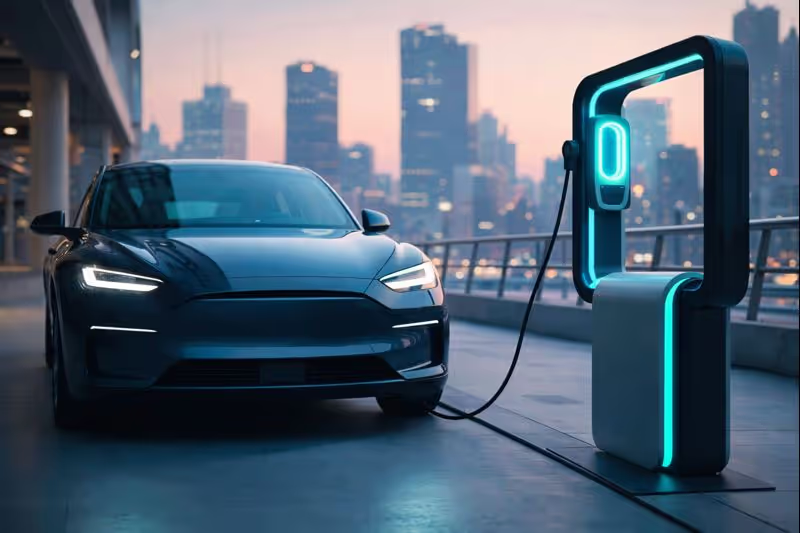
EV charging infrastructure development is critical for mass adoption. Understanding charging options is essential when evaluating how to charge an electric car.
Level 1 (Home Outlet): 2-3 kW provides 3-5 miles per hour — suitable for overnight charging with limited daily driving.
Level 2 (Home Charging Station): 7-22 kW provides 25-65 miles per hour — the optimal home EV charging solutionfor most owners.
DC Fast Charging: 50-350 kW provides 125-250 miles in 20-30 minutes — essential for road trips in electric cars.
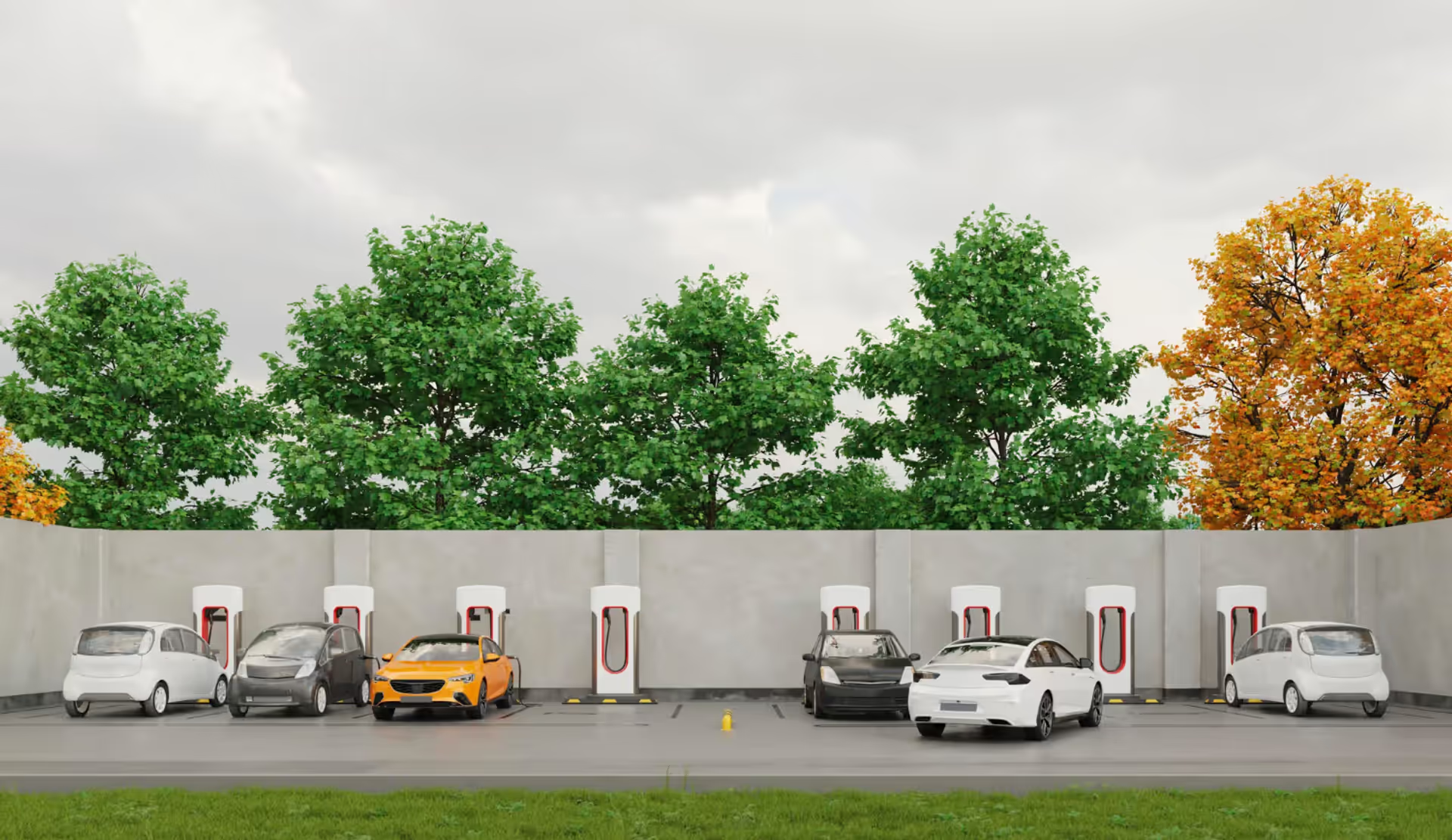
Ultra-Fast Charging (350+ kW): Available at IONITY, Electrify America, and Tesla Supercharger V4 stations, providing the fastest EV charging experience available.
Global Charging Networks: Where to Charge Electric Cars
Tesla Supercharger network — the world's largest with 50,000+ connectors. The adoption of NACS standard by other manufacturers makes this network accessible to most EVs — a key advantage when considering Tesla vs other EV brands.
Electrify America — created by Volkswagen Group, providing charging at up to 350 kW using CCS standard across major US corridors.
IONITY — European network created by BMW, Mercedes-Benz, Ford, Hyundai, and Volkswagen, with stations every 75 miles on highways.
Government EV incentives are accelerating infrastructure. The US allocated $7.5 billion through NEVI. The EU requires stations every 40 miles on major highways by 2025 — electric car incentives that benefit all EV owners.
Vehicle-to-Grid: Electric Cars as Energy Storage
V2G (Vehicle-to-Grid) technology allows EVs to return energy to the grid, acting as distributed storage systems. Vehicle owners can earn revenue by providing grid services, potentially offsetting charging costs — an increasingly important benefit of electric car ownership.
Smart charging optimizes timing based on electricity prices and grid load. Ford F-150 Lightning and other vehicles with Vehicle-to-Home (V2H) capability can power homes during outages — a compelling electric truck feature.
Best Luxury Electric Cars 2025 and Premium EV Leasing
Premium EV Comparison: Mercedes EQS vs BMW i7 vs Tesla Model S
Electric vehicles have not simply achieved parity with gasoline analogs in the luxury segment — they surpass them. Here's how the best luxury electric cars compare:
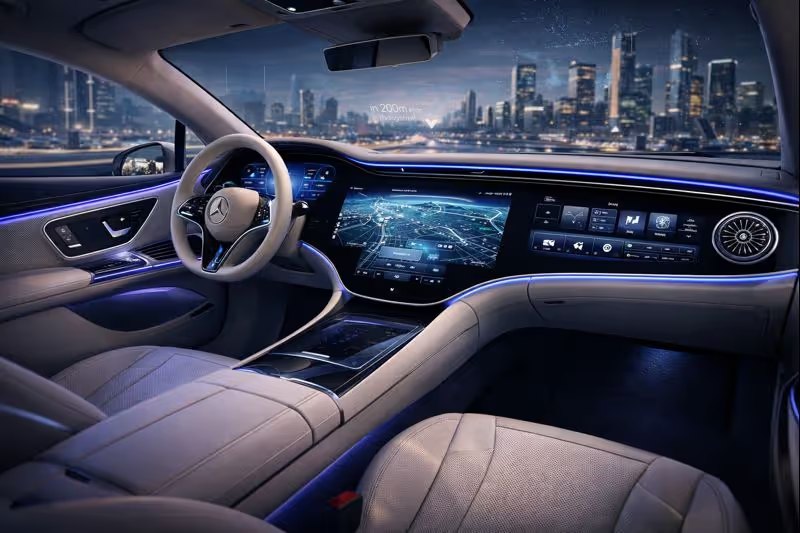
Mercedes-Benz EQS has set new standards for executive electric sedans. The MBUX Hyperscreen — a single curved display 1.41 meters wide — epitomizes the future of automotive interiors. Range up to 450 miles, aerodynamic drag coefficient of 0.20 (best in the world), and exquisite comfort make the EQS a worthy successor to the S-Class. Mercedes EQS price starts around $105,000, positioning it as a flagship luxury EV.
BMW i7 demonstrates the Bavarian approach to electric luxury. The BMW Theatre Screen, descending from the ceiling for rear passengers, transforms the cabin into a mobile cinema. The i7 M70 proves that a large luxury sedan can deliver supercar acceleration while isolating occupants from road imperfections — key advantages in the BMW i7 vs Mercedes EQS comparison.
Porsche Taycan has proven that electric vehicles can be true sports cars. Acceleration to 60 mph in 2.4 seconds (Turbo S), revolutionary 800-volt architecture, and handling matching gasoline 911s make it the benchmark when comparing Porsche Taycan vs Tesla Model S. The Taycan's launch control can be used repeatedly without performance degradation — impossible for combustion engines.
Lucid Air — the California contender — offers record range of up to 516 miles (the longest range luxury EV) and luxury comparable to Rolls-Royce, with power up to 1,234 horsepower in the Sapphire version.
Rolls-Royce Spectre became the first electric vehicle from the legendary British brand. The natural silence of electric transmission perfectly matches the "magic carpet ride" philosophy.
Tesla Model S remains the benchmark for electric car performance, with the Plaid version achieving 0-60 mph in under 2 seconds. The Tesla Model S range exceeds 400 miles, and the extensive Supercharger network provides unmatched convenience.
Electric Car Lease vs Buy: Premium Leasing Benefits
Leasing premium electric vehicles is becoming increasingly attractive, especially in an era of rapid technological development. When considering electric car lease vs buy, several factors favor leasing:
Technological relevance — Regular vehicle changes every 2-3 years ensure access to the latest batteries, autonomous driving systems, and software features. When EV technology improves so rapidly, leasing protects against obsolescence.
Protection from depreciation — Early EVs depreciated faster than expected as technology improved. EV lease dealstransfer residual value risk to the leasing company.
Fixed expenses — Monthly payments often include insurance, maintenance, and charging — simplifying budgeting and reducing total cost of EV ownership.
EV tax credits and incentives — In many jurisdictions, electric car tax credits can significantly reduce effective lease costs. Business users may benefit from favorable treatment of lease payments.
Subscription services like Care by Volvo, Mercedes-Benz Collection, and Porsche Drive offer access for a single monthly payment including everything. Some programs allow changing models at will — the ultimate in flexible car ownership.
Key Insight: In the era of software-defined vehicles, leasing and subscription are becoming optimal for those who want the best new electric cars without long-term commitment.
— Alex Johnson
Electric Car Customization and Personalization
Premium brands offer unprecedented vehicle customization opportunities:
Bespoke programs from Rolls-Royce, Bentley, and BMW allow creating unique vehicles with exclusive colors, personal embroidery, and unique material combinations.
[content]
Software features by subscription allow activating capabilities after purchase — heated seats, enhanced autonomous driving, increased power — optimizing expenses according to actual needs.
Future of Electric Vehicles — Trends and Predictions
Mobility-as-a-Service: The Future of Transportation
The concept of car ownership is transforming. For a growing number of people, mobility is becoming a service rather than an asset.
Integrated platforms combine personal cars, taxis, car sharing, bicycles, scooters, and public transport into unified ecosystems with transparent pricing and seamless transitions.
Robotaxis are expanding beyond test zones. Waymo One serves thousands of passengers daily. By 2030, autonomous taxis may become commonplace, fundamentally changing urban transportation — and the economics of car ownership vs ride sharing.
Smart Cities and Electric Vehicle Integration
Smart cities integrate traffic flows with urban systems. Parking lots direct vehicles to free spaces. Traffic lights adapt in real-time. Charging stations balance grid load — creating seamless EV urban mobility.
Zero-emission zones are expanding in London, Amsterdam, Paris, and Stockholm, stimulating electric vehicle adoptionand accelerating the transition from internal combustion engines.
Electric Air Taxis: The Third Dimension of Mobility
eVTOL (Electric Vertical Takeoff and Landing) aircraft promise to add a third dimension to urban mobility.
Joby Aviation, Lilium, Archer, and Volocopter are developing electric air taxis capable of covering urban distances in minutes. First commercial operations are expected by 2025-2026.
Automotive manufacturers including Porsche, Hyundai, and Toyota are investing in air mobility as a logical business extension — representing the frontier of future transportation technology.
Emerging Technologies: Wireless Charging and Beyond
Wireless EV charging while driving will allow vehicles to charge on equipped road lanes. Pilot projects in Sweden and Israel demonstrate technical feasibility.
Brain-computer interfaces may eventually allow controlling vehicle functions by thought — initial applications could include accessibility features or supplementary inputs.
Quantum computing could revolutionize route optimization, battery material simulation, and autonomous driving algorithms — though practical applications remain years away.
Future Vision: By 2040, automobiles may become unrecognizable — fully autonomous, electric, connected, possibly flying. They will be personal spaces for work, rest, and communication. The future of cars is electric, intelligent, and sustainable.
— Alex Johnson
Conclusion: Your Guide to Choosing the Best Electric Car
The automotive industry is at the epicenter of its greatest transformation. The convergence of electrification, autonomy, connectivity, and shared mobility is creating an entirely new paradigm of personal mobility.
Key Takeaways for EV Buyers:
For those seeking the best electric SUV: Consider the Tesla Model Y for charging network and range, Kia EV9 for family space, BMW iX for luxury, or Hyundai Ioniq 5 for value.
For luxury EV shoppers: The Mercedes EQS leads in refinement, Porsche Taycan in driving dynamics, Lucid Air in range, and Tesla Model S Plaid in performance.
For budget-conscious buyers: Tesla Model 3, Hyundai Ioniq 6, and Chevrolet Equinox EV offer excellent value. Check current EV incentives and rebates in your area.
For those considering leasing: Premium EV lease deals offer technology currency without depreciation risk — increasingly sensible as the industry evolves rapidly.
The future of mobility is already here. It is electric, intelligent, connected, and sustainable. The only question is how quickly you are ready to embrace it.
Frequently Asked Questions (FAQ)
What is the best electric car for families in 2025?
The Tesla Model Y, Kia EV9, and Hyundai Ioniq 5 offer excellent space, safety, and practicality for families.
How far can electric cars go on one charge?
Top EVs now exceed 400 miles. The Lucid Air achieves 516 miles, while the Mercedes EQS reaches 450 miles.
What is the fastest charging electric car?
Vehicles with 800-volt architecture like the Porsche Taycan, Hyundai Ioniq 5/6, and Kia EV6 charge from 10-80% in under 20 minutes
Should I lease or buy an electric car?
With rapidly evolving technology, EV leasing often makes sense for staying current. Consider lease terms, incentives, and your driving patterns.
Are there tax credits for electric cars?
Yes, many jurisdictions offer EV tax incentives. In the US, federal credits up to $7,500 are available for qualifying vehicles.
How much does it cost to charge an electric car?
Home charging typically costs $0.03-0.05 per mile — far less than gasoline. Annual EV fuel savings can exceed $1,000.
About the Author: The Drive Smart Editorial Team — automotive industry experts combining journalists, engineers, and analysts with years of experience at leading automotive publications and companies.
Related Stories
Read more


Content on edmmnatsakanyan.com is provided for general informational and educational purposes only. It is not intended to be, and should not be construed as, professional automotive, financial, leasing, or technical advice, nor as a substitute for consultation with qualified professionals.
The information provided on this website is for general informational purposes only and may include content related to cars, luxury vehicle leasing, automotive innovations, electric vehicles, and future mobility technologies. Use of this website does not create a professional, advisory, or client relationship between edmmnatsakanyan.com and the user.
Edmmnatsakanyan.com is not responsible for any errors or omissions, or for actions taken in reliance on the information contained on this website.